
INDUS WATER & LADAKH
SARASIJ MAJUMDER
There is a Sanskrit Shlokam: Part is produced below.
“बुद्धिर्यस्य बलं तस्य निर्बुद्धेस्तु कुतो बलम्।“
First half of the line says–“He who possesses intellect, possesses strength.”
Sometimes, implementing a great strategy does not require massive infrastructure; all that is needed is a simple concept—implementing an ancient technology and ingenuity with genuine goodwill using local resources. India has initiated precisely this approach regarding the waters of the Indus.
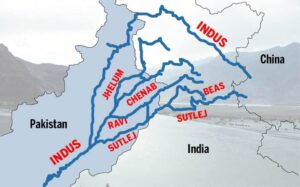
India had suspended the Indus Waters Treaty with Pakistan following the brutal killing of 26 innocent Hindu tourists in a screened terrorist attack at Pahalgam, sponsored by Pakistan, our PM declaring that “blood and water cannot flow together.”
There were reports that India was attempting to construct large dams to halt the flow of the Indus River and its tributaries—which flow through Indian territories—into Pakistan.
Pakistan’s minister Bilawal Bhutto threatened that cutting off the Indus water would lead to a “flood of blood,” while Field Marshal Asim Munir warned that any Indian Dam on Indus would be destroyed by missile strikes.
Pakistan even took the matter to the International Court of Justice, but India refused to acknowledge the court’s jurisdiction in this regard, stating India would not abide by its rulings, even if that is delivered.
However, the water through Indus continues to flow as before; India has merely stopped sharing data regarding the water flow. These series of planned interventions left Pakistan struggling—unable to predict floods or droughts, leading to widespread distress. While Pakistan was in turmoil over the lack of data and India was planning the construction of massive dams, Indian Civil Engineering experts quietly engineered a silent “Water Revolution” in Ladakh.
This did not involve building gigantic dams across the Indus or carving out massive reservoirs in the geologically sensitive mountains, a-la- China!
Instead, small “Rock-Check Dams” are being constructed using locally sourced Rocks placed on the riverbed. Furthermore, India has begun diverting glacial water into existing irrigation canals by digging simple earthen channels. A portion of the water that previously flowed bypassing Ladakh’s arid terrain into Pakistan will now be used to irrigate and green the land in Ladakh—an initiative launched by India.
But what exactly is this plan? How much will it harm Pakistan? And can India truly divert the waters of the Indus as the Pro-Pakistani Indian media making noises?
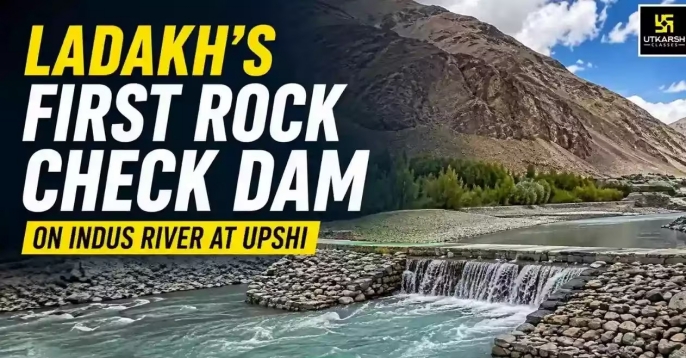
Let us understand the matter using facts and figures. Recently, Ladakh’s Lieutenant Governor inaugurated India’s first Himalayan Rock-Check Dam on the Indus River at Upshi, located about 44 kilometers from Leh. This initiative is known as the ‘Indus Water Prosperity Campaign’ (Sindhu Jal Samriddhi Abhiyan). It is situated at an altitude of approximately 11,400 feet above sea level. The dam is about 200 feet long. Its base width is 30 feet, while the width at the top is 15 feet, and it stands just five feet high above the water level. No cement, concrete, or steel was used; the dam was constructed in a mere seven days by interlocking massive boulders—weighing between 500 kilograms and 10 tons each—sourced from the surrounding area.
That initial dam was built in May, and four more have since been constructed. Question may be asked: how did a rock dam standing only five feet high become so significant?
Well, consider the Indus. In many parts of Ladakh, the river flows through deep gorges. During spring, when water levels are low, the river drops so far down below, that standard pumps cannot lift the water to higher agricultural lands. A Rock-Check Dam does not completely block the river; instead, it slows the current and creates a shallow reservoir behind the barrier. At the dam recently inaugurated in Upshi, water has accumulated over a stretch of approximately 500 meters.
That is by no means a small area; 500 meters translates to half a kilometer of accumulated water.
The water depth reaches up to 10 feet at the center. As for capacity, the reservoir can hold 40 million Liters of water. As a result, pumping water from the river into adjacent irrigation canals has become much easier. However, the excess water is not permanently trapped; it flows through the gaps of rocks, even over the top.
Yes, PERMANENT CHECK DAMS are specifically designed to safely handle water overflowing. Check Dams are intentionally designed & built as low-profile, overflow structures. They function by collecting water up to their crest height and allowing any excess volume to naturally spill over the top.
However, a flash Mud & Water flood caused by sudden melt of Glaciers or burst of Glacial Lake may cause failure.
But, Ladakh being located in rain shadow zone, and soil being sandy— chance of rain caused flood is minimal. Whatever little rain occurs—there is no surface run off.
If another dam were built on the same river further downstream near another village, that water would be captured there as well, allowing only a reduced volume to proceed to the downstream of next Check-Dam. That is how the system works. The water simply flows through the gaps between, the rocks and continues downstream. In other words, this is not a measure to halt the flow of the Indus, but rather a strategy to make the river water locally available for use. Of course, if the entire river were to be intercepted by many dams in this manner at many different locations, the volume of water would inevitably decrease. Significantly less water would flow downstream towards Pakistan.
In May, the flow of the Indus at Upshi was approximately 25 cusecs. As snow melts increasingly in July and August, the flow rises to 200 cusecs. The administration asserts that this experimental rock-check dam successfully withstood the pressure of that increased water flow—rising from 25 to 200 cusecs. Following this success, the Ladakh administration has proposed the construction of 36 small dams to the Union Ministry of Jal Shakti, with further proposals to follow. These include seven Himalayan rock-check dams on the Indus River in the Leh region and 29 RCC (reinforced cement concrete) check dams on the Suru River in the Kargil region. The estimated cost is just over ₹56 crore, covering a potential irrigation area of more than 18,600 acres.
Consider this: while constructing a single large dam often takes years and costs thousands of crores, the total proposed cost for these 36 small projects is a mere ₹56 crore. However, it is important to clarify that all these 36 dams have not yet been built; proposals have been submitted to the Centre, and the processes for approval and fund allocation are underway. The Ladakh administration reports that five rock-check dams have already been completed, yielding outstanding results.
Now, let us turn to a report about diverting 90 million Liters (9 crore Liters) of water daily. This is not part of the aforementioned check dam project; it is a separate initiative but remains part of the same broader water irrigation policy. The Stok Nala—a stream originating from the Stok Kangri glacier in Leh—used to flow through an old irrigation canal and discharge directly into the Indus River.
What did the Ladakh administration do? They simply used JCBs to dig earthen channels—or wide trenches—at just two locations. By doing so, they diverted water from the ‘Stock Nala’ (stream) into the 43-kilometer-long Igu-Phey irrigation canal. There was no need to construct a new, large canal; instead, they revitalized an old canal whose construction had originally begun in 1979. Areas that were previously dry are now brimming with water—another resounding success.
The total flow of the Stock Nala was measured at approximately 36.6 cusecs. Of this, 19 cusecs were diverted toward the Igu canal, and 7 cusecs toward the Phey canal—meaning a total of 26 cusecs is now flowing into the irrigation channels. This is by no means an insignificant volume; this additional water will bring approximately 12 villages and over 1,000 acres of water-scarce or uncultivated land under irrigation. In the future, the flow in the Igu-Phey canal could increase from 26 cusecs to around 80 cusecs. Diverting over 60 million Liters of additional water daily into irrigation canals by digging just two trenches is undoubtedly a remarkable achievement.
Now, the question arises: what does this mean for Pakistan?
The straightforward answer is that neither one nor even five check dams can completely halt the flow of the Indus River into Pakistan. While a storage capacity of 40 million Liters sounds massive, it is relatively small compared to the river’s overall flow. Moreover, the water is not being permanently blocked. Therefore, it would be incorrect to claim that Pakistan’s agricultural lands will dry up overnight. However, it would be a mistake to underestimate the strategic message here. India is demonstrating that there is no need to wait for the construction of massive dams; river water levels can be raised using smaller barriers. Glacier-fed streams can be connected to existing canals. By simply excavating some earth and replicating this method in various locations, India can vastly increase its utilization of its own water resources in Ladakh. A single check dam will not cause a crisis for Pakistan. Five check dams alone might not cause significant issues. However, if hundreds of small water-retention schemes—such as Check Dams, Irrigation Canals, Reservoirs, And Hydroelectric Projects—are interconnected across the Indus and its Tributaries, their cumulative impact would undoubtedly be immense. These projects offer additional advantages. Constructing large dams entails environmental damage, land acquisition, the displacement of populations, and the risks associated with impounding vast quantities of water in earthquake-prone zones. In contrast, Rock Check Dams are far more cost-effective; they can be built quickly, and if damaged, repairs can be carried out using locally available Rocks.
Clearly, the approach India is adopting in the Himalayas cannot be taken lightly. While it might be an exaggeration to label these Rock, and Concrete Check Dams as a “terrifying water bomb” against Pakistan at this moment, their impact will be substantial once hundreds of them are constructed. Conversely, dismissing them merely as ordinary village irrigation schemes would mean ignoring their strategic significance. The crux of the matter is that India has not limited itself to international treaty diplomacy or discussions about massive dam projects regarding the waters of the Indus. Instead, it has begun utilizing its rightful share of water within its own territory through small-scale, practical measures at a very low cost.
These are not massive diversion canals, but merely small rock-built barriers across the river—essentially two earthen trenches dug by JCBs. Yet, if these modest measures can turn thousands of acres of arid Ladakhi land green, it signifies more than just water conservation; it represents a silent water revolution for Ladakh, & India. And that is precisely what has happened and is happening.
That is the key point. The Indus flows through the heart of Ladakh, yet farmers there often cannot cultivate their land due to lack of water. India has initiated efforts to rectify this historic anomaly—not through borrowed technology, but through ancient wisdom of these smaller interventions.
The message to Pakistan is also clear: the waters of the Indus flow through Indian territory, and the era of India simply letting whole of that water flow downstream to Pakistan without utilizing it in India has ended. By diverting the water in this manner, a significant portion will undoubtedly be retained within India, leaving far less to reach Pakistan.
There will be no need to construct massive reservoirs or dams to halt the flow of water to Pakistan. India’s new strategy is so innovative that Pakistan is at a loss as to how to respond. Had a large dam been built, the option of destroying it with a missile strike would have been effective. But if no such large dam is constructed at all, where exactly would they target their missiles? The question of a missile strike simply loses military relevance! This is this predicament that Pakistan finds itself in—and unable to raise any objection.
India has executed a brilliant, ingenious move.
Those days of “PAKISTAN FIRST” policy of MKG & JLN are over.
Is China listening?? Don’t try to show your big muscle of Technology in environmentally sensitive zone! Not needed. We can handle Brahmaputra.
That is why I quoted at the beginning, India’s ancient wisdom: “Where there is intellect, there is strength.”
SOURCES: GOI REPORTS, Handbook of Civil Engineering, Public Domains. Numbers are not checked and taken from DOMAIN.
NOTE: The ‘BLOGGER’ is a Civil Engineer with experience over 50 years and visited Ladakh 3 times.
![NAVA-RATRA [ NINE NIGHTS]](https://sarasijmajumder.in/wp-content/uploads/2026/10/RAVAN-PORA-1.jpg)