
STARLINK AND INDIA
SARASIJ MAJUMDER
Starlink is a low-orbit satellite-based internet and communication system developed and operated by SpaceX that delivers high-speed, low-latency broadband coverage across more than 160 countries.
How Starlink Works
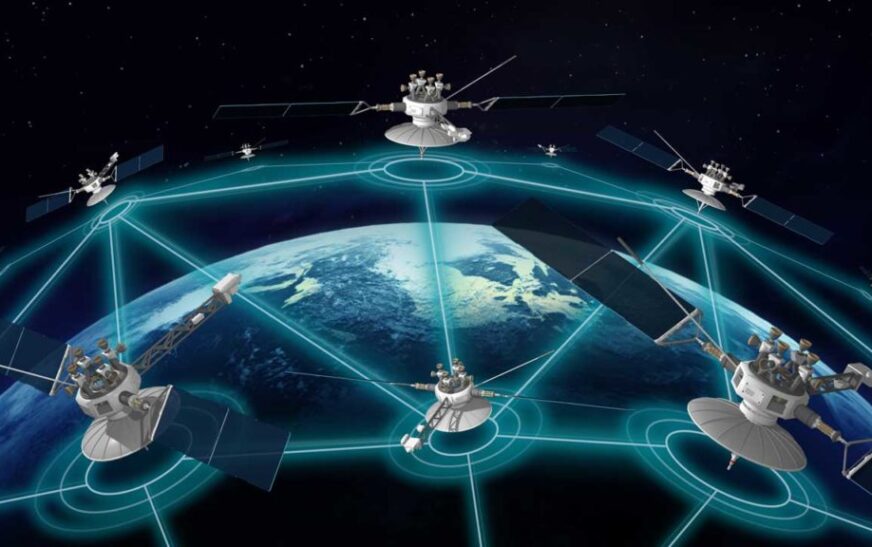
- Low Earth Orbit (LEO) Satellites: Unlike first generation satellite system that use distant geostationary orbits (about 35,000 km away), Starlink uses a massive constellation of thousands of small satellites orbiting at roughly 500 km above Earth.
- Reduced Latency: Because the satellites are much closer to the ground, signal travel time drops significantly, allowing real-time tasks like video calls and online gaming more enjoyable.
- User Terminal (Dish): Customers set up a compact, self-aligning phased-array antenna (“Dishy”) that electronically steers radio waves to track moving satellites without needing physical moving parts.
- Laser Links and Gateways: Satellites pass data to each other using inter-satellite laser links and route it down to ground gateway stations connected to the terrestrial internet backbone.
Key Components
- Space Segment: Over 10,000 operational LEO satellites moving in orbit.
- User Hardware: A Starlink Kit containing the flat-panel antenna dish, a Wi-Fi router, and power cables.
- Ground Infrastructure: Gateways and ground stations that bridge space signals to standard fiber and data centers.
Availability in India
Starlink is currently not commercially available or licensed in India, as it remains subject to the approval of regulatory framework, spectrum assignment, and security clearances required from the Department of Telecommunications (DoT).
MOBILE CONNECTIVITY:
Starlink connects directly to cell phones through an emerging technology called Direct to Cell (DTC).
Instead of requiring a satellite dish or any special modifications to your phone, this system allows unmodified, standard 4G LTE/5G smartphones to communicate directly with Starlink’s specialized satellites overhead.
How it Works: Cell Towers in Space
- Satellite Upgrades: SpaceX has launched hundreds of specialized Direct to Cell satellites equipped with advanced modems and massive 25-square-meter phased array antennas. These antennas act like cellular towers orbiting at roughly 320 to 360 kilometers above Earth.
- No Special Hardware Required: The satellites are powerful enough to “hear” the small radio signals emitted by standard cell phones, removing the need for dedicated satellite phone hardware.
- Primary Purpose: It is designed as a supplemental coverage safety net to erase carrier “dead zones” in remote areas, wilderness, or off-grid locations rather than replacing standard urban cell service.
Services and Rolling Capabilities
The Direct to Cell infrastructure is designed to roll out features progressively as the satellite constellation scales up:
- Text Messaging: Active in multiple regions, powering basic SMS and messaging across dead zones.
- Voice and Light Data: Upgraded capabilities push bandwidth speeds up to 150 Mbps, paving the way for native phone calls, basic internet browsing, and video calls.
- Future Carrier Plans: SpaceX has acquired mobile spectrum licensing with the goal of expanding infrastructure to become a major standalone cellular carrier.
Global Carrier Partnerships
Starlink works by partnering with existing local mobile operators on six continents to seamlessly pass your signal to the satellites when you walk out of traditional tower range:
- United States: Partnered with T-Mobile (rebranded locally as “T-Satellite”).
- Other Major Markets: Partnered with Optus and Telstra (Australia), Rogers (Canada), KDDI and SoftBank (Japan), VMO2 (UK), and Deutsche Telekom (Europe).
- Status in India: Both Reliance Jio and Bharti Airtel have discussed and signed structural frameworks to bring satellite services to local customers. However, the service cannot go live until the Department of Telecommunications (DoT) allots final commercial spectrum and provide security clearances.
Here is the breakdown of device compatibility, global cellular pricing models, and the latest landmark regulatory developments in India.
📱 Compatible Smartphone Models
Because Direct to Cell functions as standard LTE/5G “cell towers in space,” it uses standard mobile frequencies. Any smartphone that can pick up traditional 4G LTE or 5G roaming and network bands is technically capable of receiving the satellite broadcast.
During the initial global rollouts and public beta testing, global carriers (like T-Mobile’s T-Satellite) have verified broad compatibility across major modern phone lineups as below:
- Apple: iPhone 13, 14, 15, 16, and newer series (enabled natively via system updates).
- Samsung: Galaxy S21 and newer, the Galaxy Z Fold and Z Flip series (from Gen 3 onwards), select Galaxy A series (A14–A54), and rugged XCover 6/7 Pro devices.
- Google: Pixel 9 series and newer.
- Motorola: Modern 2024–2025 lineups including the razr, edge, and moto g series.
Any Nokia phone that supports 4G LTE connectivity is technically compatible with Starlink’s “Direct to Cell” satellite network.
💳 How the Pricing Works on Mobile Plans
You do not pay Starlink directly for the cellular feature. Instead, the capability is sold directly through your paired mobile network provider. Looking at the established model with US partner [T-Mobile], the pricing uses a two-tiered structure:
- Premium Tiers (Free Add-on): Included automatically at no extra charge if you are subscribed to top-tier, premium post-paid unlimited mobile plans (e.g., Go5G Next or Experience Beyond packages).
- Standard Tiers (Add-on Fee): If you are on an older or lower-cost plan, you can add space-based roaming to your line for $10 per month.
- Cross-Carrier Access: To prioritize emergency safety nets, some regions allow rival network users (like Verizon or AT&T) to activate a downloadable eSIM to use the service in off-grid dead zones for a similar standalone monthly fee.
Current Regulatory Status in India
The regulatory landscape for Starlink in India has shifted significantly following historic milestones cleared by the Department of Telecommunications (DoT).
- Licensing Approval: Starlink has formally received its initial operating license from the DoT, making it the third official entity cleared to provide satellite internet services in India alongside Eutelsat OneWeb and Jio Satellite Communications.
- Trial Spectrum Window: With the license approved, the government is set to allocate trial spectrum within 15 to 20 days of formal application, allowing Starlink to finally test its network infrastructure on the ground.
- The Government Stand: Telecom Minister Jyotiraditya Scindia clarified that while India welcomes the technology and actively prevents commercial monopolies, strict domestic laws, pricing frameworks, and national security clearances must be fully satisfied before any commercial launch keys are turned over.
Local telecom giants Reliance Jio and Bharti Airtel are using a multi-layered strategy to compete with Starlink. Rather than engaging in a pure space-to-ground tech war, they are weaponizing their existing market dominance, proposing native satellite constellations, and even partnering with Elon Musk to control how the service reaches Indian consumers.
- 1.The “Frenemy” Strategy: Controlling Distribution
In a massive twist, Jio and Airtel signed agreements with SpaceX to act as Starlink’s physical distribution network.
- The Playbook: Instead of letting Starlink sell directly to consumers online, Jio and Airtel will sell Starlink equipment through their massive brick-and-mortar retail stores and online storefronts.
- The Advantage: By handling customer service, installation, and hardware activations, the local carriers ensure they retain the primary customer relationship and earn revenue from Starlink’s ecosystem.
- 2.Building Parallel Domestic Satellite Constellations
Both carriers are establishing their own independent space infrastructure to ensure long-term data sovereignty and network independence:
- Reliance Jio’s Sovereign Network: Jio has showcased plans for its own constellation of roughly 1,600 Low Earth Orbit (LEO) satellites paired with 23 domestic ground stations. By routing data strictly within Indian soil, Jio satisfies national security guidelines more natively than foreign operators.
- Airtel’s OneWeb Backbone: Airtel is leveraging its deep structural integration with Eutelsat OneWeb, an already established global LEO satellite operator. Airtel plans to deploy this network to handle enterprise-grade business connectivity and backhaul for remote cell towers.
- 3.Aggressive Pricing
The ultimate battleground in India is pricing. Ground-based mobile data in India costs roughly 8 cents per gigabyte, among the lowest rates in the world.
- The Playbook: Jio and Airtel offer premium fiber broadband plans (up to 300 Mbps) for around ₹1,499 to ₹1,599 per month. In comparison, Starlink’s standard hardware kit can cost upwards of ₹20,000, with monthly fees scaling much higher.
- The Edge: Local carriers will heavily discount their terrestrial and hybrid satellite packages to keep urban and semi-urban consumers locked into their traditional ecosystems. Musk has already publicly acknowledged that Starlink will be forced to drastically adapt its pricing to match India’s ultra-competitive economics.
- 4.Regulatory Lobbying over Spectrum
A major point of contention has been how the Indian government hands out satellite spectrum.
- Jio heavily lobbied the government to auction satellite spectrum, arguing that a standard auction creates a fair playing field for domestic investments.
- While the government ultimately decided on administrative allocation (licensing)—a win for Starlink—Jio and Airtel continue to push the Telecom Regulatory Authority of India (TRAI) for strict pricing parity and security audits to ensure foreign networks don’t get an unfair market advantage.
the satellite internet landscape features several global and domestic operators. In India, these platforms operate under the Global Mobile Personal Communication by Satellite (GMPCS) licensing framework and are progressing toward active deployment.
The primary alternative satellite options include:
- Eutelsat OneWeb
Backed heavily by the UK government and Bharti Airtel, OneWeb is Starlink’s closest active competitor.
- The Technology: It operates a constellation of over 600 Low Earth Orbit (LEO) satellites.
- Target Audience: OneWeb focuses strictly on B2B (business-to-business), government infrastructure, maritime tracking, and providing cellular backhaul for remote mobile towers rather than direct-to-consumer individual kits.
- India Status: OneWeb was the first to secure initial structural clearance from India’s space regulator, IN-SPACe.
- JioSpaceFiber (Reliance Jio & SES)
Reliance Jio partnered with Luxembourg-based satellite giant SES to build a dedicated domestic option.
- The Technology: Instead of LEO, JioSpaceFiber utilizes a hybrid network anchored by Medium Earth Orbit (MEO) satellites (using SES’s O3b and O3b mPower infrastructure). This allows them to deliver multi-gigabit speeds over highly specific regions.
- Sovereign Constellation: To secure total independent data transmission, Jio has also proposed launching its own domestic fleet of approximately 1,600 LEO satellites.
- Target Audience: Bridging rural gaps via fixed “Air Fiber” towers and high-speed community connections.
- Amazon Project Kuiper
Amazon’s high-profile, upcoming satellite broadband system represents a direct direct-to-consumer rival to Starlink.
- The Technology: Project Kuiper plans a constellation of over 3,200 LEO satellites designed to beam internet to small user terminals.
- The Edge: Deeply integrated with Amazon Web Services (AWS) cloud infrastructure and consumer e-commerce platforms.
- India Status: Amazon is actively engaging with the Indian government to clear regulatory hurdles, positioning India as a primary focus market.
- Hughes Communications India
An established veteran in the satellite sector, Hughes operates heavily in the enterprise space.
- The Technology: Rather than low-altitude LEOs, Hughes primarily uses massive Geostationary High-Throughput Satellites (HTS) using their specialized JUPITER System architecture.
- Target Audience: Corporate offices, banking networks (powering off-grid ATMs), and remote retail sites requiring highly stable, dedicated point-to-point connections.
LEO vs. MEO vs. GEO: A Quick Look
- LEO (Starlink, OneWeb, Project Kuiper): Orbit at 500–1,200 km. They offer the lowest latency (30–50ms) but require thousands of moving satellites to maintain coverage.
- MEO (JioSpaceFiber): Orbit at 2,000–20,000 km. They feature moderate latency but provide massively dense data bandwidth over focused geographic target spots.
- GEO (Hughes, Viasat): Orbit at 36,000 km. Just one satellite can cover a third of the Earth. Latency is much higher (~500ms+), making it ideal for static data operations or broadcasting rather than real-time cellular calling or gaming.
| I THINK GOI SHOULD HAVE WAITED BEFORE DECIDING ON *STARLINK*. |
WHAT EMERGE:
The Best for Most People in India: Jio & Airtel Fiber / 5G
For 90% Of Indian Households, Traditional Ground-Based Broadband or Mobile Networks Remain the Best Choice for Foreseeable Future.
- Best For: Urban cities, towns, and well-connected semi-urban areas.
- Cost Advantage: Entry-level fiber plans from Reliance Jio and Bharti Airtel cost between ₹399 and ₹499 per month, offering solid speeds and bundled OTT subscriptions.
- The Verdict: If you can get a physical fiber cable or a stable 5G “Air Fiber” fixed-wireless connection at your home, skip satellite internet entirely. It is exponentially cheaper, offers unlimited data caps, and provides the lowest latency for daily streaming, downloading, and gaming.
📡 The Best for Remote & Off-Grid Individuals: Starlink or its equivalent:
Once final commercial launches clear the government’s security assessments, Starlink will be the undisputed champion for extreme coverage.
- Best For: Mountainous regions (like Ladakh or Himachal Pradesh), deep forest areas, off-grid farmlands, island territories, or areas prone to natural disasters where cell towers collapse.
- Performance Edge: Starlink’s massive Low Earth Orbit (LEO) network delivers true high-speed broadband with incredibly low latency (30–60ms), which traditional satellites cannot match.
- The Catch: Expected pricing sits between ₹2,500 and ₹3,500 per month, plus an upfront hardware kit cost that could exceed ₹30,000. It is a premium safety net, not a mass-market budget option.
🏢 The Best for Small Businesses & Rural Offices: Eutelsat OneWeb
If you are running a rural commercial enterprise, a highway warehouse, or a remote construction project, OneWeb is highly optimized for your needs.
- Best For: B2B environments, remote bank ATMs, schools, maritime vessels, and small rural enterprise setups.
- The Edge: Backed structurally by Bharti Airtel, OneWeb focuses heavily on robust, secure enterprise connections and acting as the cellular backbone to light up remote local mobile towers.
The Best for Sovereign & National Security: JioSpaceFiber
From a national infrastructure perspective, Jio’s sovereign satellite initiative holds massive long-term value for the country.
- Best For: Keeping Indian data entirely within Indian borders.
- The Edge: Jio is planning a network of 1,600 domestic LEO satellites paired with 23 ground stations across the country, aiming to natively cover over 600,000 villages. Because it bypasses foreign data routing, it will likely be heavily utilized by the Indian government, public sector undertakings, and rural community Wi-Fi programs.
Summary Recommendation
- Choose JioFiber or Airtel Xstream if they are physically available on your street.
- Investigate JioSpaceFiber or OneWeb solutions if you are managing a rural business site or village community center. Or,
- Wait for Starlink or its equivalent if you live entirely off-grid, travel in deep wilderness, or require high-speed internet where no cellular signal exists.
SOURCES:
Navigation, and communication Journals.
Information available in Public Domains.
I am allowed to use ‘EIL’ Library—which I do when needed.
https://sarasij1majumder.blogspot.com/2026/10/elon-musk-indian-mirjafars.html