

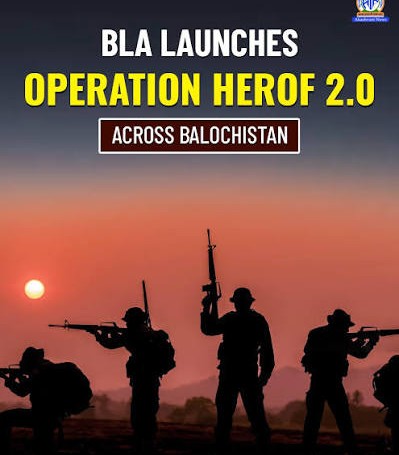
FUTURE OF BALOCHISTAN
SARASIJ MAJUMDER
Many readers of my BLOGS, and NEWS & VIEWS, recently asked me— ‘Is Balochistan going to be an independent state soon?’ They are asking as I started covering the incidents there under separate heading in ‘NEWS & VIEWS’.
Balochistan is rather historically a geographic and cultural region divided among Pakistan, Iran, and Afghanistan. What we discuss here is about the region under control by PAKISTAN.
There are many complex factors involved to answer this question in one word. Let us collate the related incidents with at least past 10 years’ time frame, and see what is emerging, and possibly will emerge.
The Balochistan Liberation Army (BLA) is launching one after another deadly attacks on the Pakistan Army, resulting in the deaths of many Pakistani soldiers. It is safe to say that Balochistan is rapidly moving towards emerging as an independent state, constantly increasing pressure on Pakistan day by day. Now, there is a difference between slicing a cake in two parts and partitioning a country or eking out an independent national state from an existing country.
It takes several generations—even then it may fail. TAMIL EELAM is the example. But ‘BANGLADESH’ is a success! India under Indira, and India under Rajiv, acted in opposite direction in those cases.
A good MIDWIFE is needed to deliver the BABY!
If we look at the GEO -POLITICS of Pakistan, excluding Balochistan—we see Pakistan is in a very bad shape. POK is burning, and asking for independence from Pakistan, and merger with INDIA.
SIND is simmering with discomfort.
KHYBER- PAKHTUN region is fighting for independence.
Afghanistan is in war with Pakistan. They never accepted ‘DURAND LINE’.
INDIA has ended ‘OPERATION SINDOOR’ and India is ready to continue if need be.
Indus water agreement is cancelled. Probably forever.
Thus—except PUNJAB province of Pakistan, rest of the region is very hot!
Too much inner discontents, which are ready to explode.
Now let us focus on Balochistan. Baloch separatists utilize “hit-and-run” tactics, remote safe havens in the vast, rugged topography of the province, and temporary blockades.
From 2011 to 2026—in these 16 years, we see these has happened:
- My primary information sources are three: DAWN of Pakistan which is under reporting; Al-Jazeera, which is cautiously pro-Pakistan, and two e-papers from Balochistan— ‘Daily Balochistan Express’ & ‘Quetta Voice’ for regional news, updates, and local developments. They are also releasing VDOs after every major incident as a PROOF!
- Casualty of Pakistan Army caused by ‘Baluchistan Liberation Army’ (BLA) has risen from 121 in 2021 to 454 in 2025. It’s over 450 in 2026 so far, which has more than 3 months to end. The casualty rose steadily, year after year, the BLA is eliminating more Pakistani soldiers than in the previous year. BLA is becoming stronger.
Key Drivers of Recent Escalation–High-Profile Targets: Insurgent networks have increasingly utilized complex suicide wings (such as the BLA’s Majeed Brigade) targeting key military infrastructure, check posts, and transit lines. Coordinated Offensives: Recent spikes are fuelled by simultaneous multi-city assaults, such as the January 2026 attacks across 10 districts that claimed at least 17 security lives in a single day.
3.0 The newspaper reports where the BLA claimed responsibility for all the killings. The BLA went a step further——by releasing videos showing exactly where, how, and against whom the attacks were carried out. A proven, documented report.
- Area under Baloch control: It has considerably increased and will continue to increase.
The Makran Coastal Belt (Gwadar, Kech, Panjgur) High Contestation: The core operational hub for the BLA and BLF. Insurgents utilize the mountainous terrain for transit and frequently target infrastructure related to the China-Pakistan Economic Corridor (CPEC). Coordinated multi-district assaults in early 2026 and mid-2026 targeted coast guard vessels, security outposts, and local transport networks.
Central Balochistan (Kalat, Mastung, Nushki, Surab) Temporary Seizures: A highly volatile corridor where militant factions leverage critical highway chokepoints to disrupt state movement. In mid-2025, BLA fighters briefly claimed temporary control over Surab City for several hours, setting up checkpoints and damaging state property before military counter-operations forced a retreat. Mastung faced a highly publicized insurgent-led prison break in 2026.
Northern & Pashtun-Populated Belts (Quetta Outskirts, Ziarat) Spillover Zones: Historically less prone to Baloch separatism, these areas have increasingly faced high-lethality hit-and-run operations. In late 2026, severe ambushes took place outside Quetta (such as in Shaban) and near Ziarat, targeting military convoys passing through transit routes.
What Emerge:
Above proves that Liberation Movement is rather well spread over most of the region today and has taken deep roots. Pakistan army failed to control this over a period of time.
5.0 A fourth point to understand is the BLA’s level of accuracy. For an organization to repeatedly launch attacks against the national army with such pinpoint precision implies that their intelligence capabilities are extremely strong. The BLA certainly doesn’t have access to satellite-based intelligence, then what do they have? Local Intelligence. This signifies that the BLA possesses a formidable local support base. When the local population stands against the state government, the state apparatus, or the state army, the State-Pakistan and its army is rendered powerless. Locals can relay information and navigate the terrain like the back of their hand—capabilities that an army soldier posted to Balochistan from Pakistan’s Punjab province simply cannot match. Currently, a curfew has been imposed across large swathes of Balochistan to bring the situation under control. The Pakistani army is facing immense pressure from the entire nation, and the country is suffering a loss of face internationally.
it is not a simple task—it is not child’s play. Balochistan *will* become independent; nothing can stop it. based on pure geopolitical calculations.
6.0 Pakistan’s Reaction:
So, what are they doing now? In desperation, security forces in Balochistan are picking up, interrogating, beating, and torturing anyone they come across on the streets; if anyone’s statements seem incoherent or suspicious, they are arrested or even killed. The consequence of this is that the next generation in Balochistan—the current teenagers—are turning completely against Pakistan. When a father, grandfather, or family member is abducted and tortured, the children in those households internalize a single, deep-seated conviction: “We are enemies of Pakistan; Pakistan is our enemy.” Consequently, Balochistan is gradually slipping out of Pakistan’s control.
The situation is not improving for Pakistan; Balochistan was drifting away and turning against the state.
WHAT OTHERS SAY?
China is unhappy with Pakistan—or rather, no longer pleased with them. Who says so? Fazlur Rahman. And who is Fazlur Rahman? He is the chief of the JUI-F, a political party there—Jamiat Ulema-e-Islam (F). Naturally, one wouldn’t expect the chief of such a Pakistani party to speak negatively about the country, yet he states that Beijing is withdrawing from mining projects in Balochistan. As we know, Balochistan is rich in minerals—including critical ones like copper and gold—and Pakistan had invited China to mine those minerals.
Now, China is abandoning these projects because BLA i.e. local revolutionaries and fighters are repeatedly attacking Chinese engineers. This is said by a Pakistani leader. You get the picture.
And we know, China is pulling out of these projects. Some speculate—though I cannot confirm this—that China might be signalling India: “We are withdrawing from projects in Pakistan; India too, should increase cooperation with us.” It is possible that Ajit Doval, Dr. Jaishankar, PM Modi, and senior PMO officials will meet to deliberate on the next steps.
SOME LOGICAL ASSUMPTIONS:
We also know the US has an interest in Pakistan; this is due to Pakistan’s strategic location, which allows for surveillance and potential action against three countries: Iran, Afghanistan, and China. Pakistan needs funds; the US provides loans through institutions like the IMF and World Bank, and in return, Pakistan does the “DIRTY WORK’ for America. However, recall that a few months ago, Donald Trump spoke about US investment in offshore crude oil exploration in Pakistan, yet there is still no visible sign of work actually starting on the ground, rather sea. Perhaps this lack of activity is due to the fear that Iran—which has been attacking US bases across the Middle East and Gulf nations—might target such projects. After all, Pakistan is right next to Iran; if work were to begin there, Iran might launch an attack. That is a possibility.
These points are based on logical assumptions, whereas the earlier ones were backed by evidence. Now, let’s move to the next level.
Consider Maryam Nawaz, the Chief Minister of Punjab of Pakistan. Just as we have figures like Yogi Adityanath or Shuvendu Adhikari serving as Chief Ministers of various states, Maryam Nawaz holds the position of Chief Minister of Punjab (Pakistan). She is the daughter of Nawaz Sharif—the former Prime Minister. The people of Pakistani Punjab—the Punjabi Pakistanis—tend to enjoy the lion’s share of Pakistan’s wealth while regarding others as mere subordinates.
Look at her recent statement: Maryam Nawaz claims that Pakistan’s Punjab faces a greater threat from neighbouring provinces like Balochistan and Khyber Pakhtunkhwa than from neighbouring countries like India and Afghanistan. She is the sitting Chief Minister of Punjab—the most powerful state—and the daughter of a former Prime Minister and niece of the current one; naturally, there should not be any question on her political acumen or maturity.
She has said—regarding Punjab, the state where he serves as Chief Minister—that the threat may not come from India; the threat stems from Afghanistan.
The greater threat arises from Balochistan and Khyber Pakhtunkhwa; an attack could occur at any moment from those regions.
Please ponder over this.
I was watching her video where she spoke about ensuring Punjab’s security—from Balochistan? Khyber Pakhtunkhwa? And who is in Khyber Pakhtunkhwa? The TTP—Tehrik-i-Taliban Pakistan; I hope you remember that. She claimed they may compromise Punjab’s security on AI.
You might recall that Pakistan’s Défense Minister, Khawaja Asif, made some bold threats about attacking India, and their Foreign Minister, Mr. Bhutto, said the same—yet, they are yet to actually launch an attack.
However, I believe that eventually, with their backs against the wall, they may be compelled to attack India, inviting their ‘DOOMS DAY’.
The moment they launch an attack on India, Afghanistan and Balochistan will retaliate. Consequently, facing attacks from three fronts, Pakistan would be disintegrated. India will get back ‘GILGIT-BALTISTAN’
But there is significant work to be done in, and for Balochistan. A specific agency needs to take charge—or perhaps, in my view, they already have.
WHAT EMERGE:
I THINK, BALOCHISTAN IS ALREADY ON THE WAY FOR FREEDOM, BUT LOT MORE ARE YET TO BE DONE. FROM PRESENT POSITION—PAKISTAN IS LOSING GROUND. ONE WRONG STEP—AND PAKISTAN WILL DISINTEGRATE. AND THE WAY IRAN WAR IS HEADING—PAKISTAN’S USEFULNESS TO USA MAY BE OVER. BRICS GAINING STRENGTH.
1 Comment
SOME NUMBERING AUTO CORRECTION WILL BE SET RIGHT. Sorry