PROTEST MECHANISMS IN DEMOCRACY
REVIEW W.R.T. CJP MOVEMENT
SARASIJ MAJUMDER
In a democratic society, protest mechanisms are the legally protected channels and methods that citizens use to express dissent, demand accountability, and influence public policy.
Protest mechanisms function as a core pillar of democracy, ensuring that public power remains responsive to the populace between election cycles. These mechanisms are generally categorized by their approach:
- Expressive & Assembly-Based Mechanisms:
- Demonstrations and Marches: Public gatherings where individuals walk or assemble along a designated route to visibly project solidarity for a specific cause.
- Rallies and Vigils: Stationary gatherings in public squares, outside government buildings, or at symbolic sites to deliver speeches, remember victims, or draw attention to an issue.
- Picketing: Stationing individuals outside a workplace, government building, or event to disrupt normal operations, deter entry, and inform the public of a grievance.
- Institutional & Legal Mechanisms
- Petitions: Formal, written requests signed by citizens that constitutionally or legally compel a government body to consider a specific policy, debate an issue, or trigger a referendum.
- Litigation and Legal Challenges: Utilizing the judicial branch to challenge the constitutionality or legality of executive actions, legislation, or corporate behaviors.
- Lobbying and Public Hearings: Engaging directly with elected officials or participating in statutory public comment periods to voice opposition to proposed regulations.
- Economic Dissent Mechanisms
- Boycotts: The organized refusal to purchase goods, utilize services, or participate in events associated with a specific corporation, state, or entity to exert financial pressure.
- Strikes and Work Stoppages: The collective refusal by employees to work, aimed at forcing employers or governments to address labor rights, economic policies, or broader political grievances.
- Divestment Campaigns: Pressuring public institutions, universities, or pension funds to withdraw investments from specific industries or countries.
- Digital & Communicative Mechanisms
- Digital Activism (Slacktivism/Hacktivism): Utilizing social media campaigns, coordinated hashtags, online petitions, or targeted digital disruptions to amplify global awareness.
- Whistleblowing and Leaks: Exposing classified or confidential institutional corruption, illegal activities, or systemic failures to the public through journalists or oversight bodies.
- Artistic and Cultural Subversion: Deploying street art, theater, music, and political satire to criticize authority and reshape public discourse.
- Non-Violent Civil Disobedience
- Sit-ins and Occupations: Physically occupying a space (such as a government office, university square, or corporate headquarters) and refusing to leave to disrupt business-as-usual.
- Blockades: Obstructing critical infrastructure—such as roads, railways, or ports—to force immediate governmental or corporate attention to a crisis.
- Tax Resistance: The deliberate refusal to pay certain taxes as a conscientious objection to specific government policies, such as military spending.
I have only described above for understanding only. Indian constitution doesn’t explicitly approve all above.
The Constitution of India does not explicitly mention the phrase “Right to Protest.” Instead, this right is implicitly derived, elaborated, and protected through a combination of Fundamental Rights under Part III of the Constitution.
- The Core Constitutional Provisions
When citizens protest, they are simultaneously exercising three distinct sub-clauses of Article 19(1):
- Article 19(1)(a) – Freedom of Speech and Expression: This grants citizens the right to voice their opinions, dissent, critique government policies, chant slogans, and mobilize public opinion.
- Article 19(1)(b) – Right to Assemble Peaceably and Without Arms: This is the direct legal backing for marches, rallies, sit-ins, and demonstrations. It explicitly allows people to physically gather to collectively express their grievances. But it shall be strictly non-violence.
- Article 19(1)(c) – Right to Form Associations or Unions: This provides the legal framework to form groups, trade unions, or activist organizations to plan and coordinate collective actions.
- The Elaborated Limits: “Reasonable Restrictions”
The Constitution balances individual freedoms with collective security. The right to protest is not absolute. The Constitution elaborates on the state’s power to restrict protests under Articles 19(2) and 19(3), provided the restrictions are “reasonable” and based on specific grounds:
- The sovereignty and integrity of India
- The security of the State
- Public order (the most common ground used to regulate crowd management and locations)
- Decency or morality
- Contempt of court or incitement to an offence
- How the Supreme Court Elaborated the Right
Because the text of the Constitution is concise, the Supreme Court of India has progressively expanded and defined what the right to protest means in practice:
- Dissent as a Safety Valve: In the landmark Ramlila Maidan Incident (2012), the Supreme Court ruled that peaceful protest is a fundamental right and acts as a vital safety valve for democracy. Arbitrary state action cannot take it away. BUT SC DIDN’T DEFINE WHAT IS ARBITRARY.
- Regulation vs. Prohibition: In Himat Lal K. Shah (1973), the court made it clear that while the state can regulate public meetings to maintain traffic and order, it cannot completely ban or prohibit public meetings altogether. Again, the ruling is vague. How much is completely? Number of persons/ space need to be frozen.
- The Right to Move vs. The Right to Protest: In the Shaheen Bagh Case (2020), the Supreme Court elaborated that while the right to protest is protected, protesters cannot occupy public roads or spaces indefinitely if it significantly hinders the right to free movement of other citizens. Protests must take place in designated areas. A reasonable Judgement—but how much is Significant? 50%?—80%,? Still vague.
- The Citizen’s Fundamental Duty
The Constitution balances this right with a duty. Under Article 51A(i) (Fundamental Duties), every citizen has a constitutional responsibility to safeguard public property and to abjure violence. Therefore, once a protest turns violent, it loses its constitutional protection under Article 19.
On the ground, local authorities and police regulate protests by relying heavily on statutory preventive powers. Section 163 (replaced Section 144 of the old Code of Criminal Procedure (CrPC) of the Bharatiya Nagarik Suraksha Sanhita (BNSS) serves as the primary tool to control public assemblies. However, the core mechanics of the power remain nearly identical, but it operates under this new statutory framework.
Police forces use these statutory provisions to manage, restrict, or disperse protests through several key mechanisms:
- Imposing Prohibitory Orders
Section 163 empowers an Executive Magistrate (such as a District Magistrate or Sub-Divisional Magistrate) to issue written orders to prevent “apprehended danger, nuisance, or obstruction to public safety.”
- The “Rule of 5”: The most common application during a protest is to legally ban the assembly of five or more people in a specific area.
- Preventing Mobilization: By declaring an area under Section 163, the police can stop protesters from gathering at crucial spots like parliament houses, secretariats, or major highways before the demonstration even begins.
- Turning a Gathering into an “Unlawful Assembly”.
If a Section 163 order is active in an area and protesters gather anyway, the nature of the protest changes legally:
- The gathering is immediately classified as an unlawful assembly.
- Police then have the legal authority under Section 148 of the BNSS to command the crowd to disperse.
- If the crowd refuses to disperse, police are legally permitted to use “civil force” (which manifests on the ground as barricading, water cannons, tear gas, or a lathi charge) to clear the area.
- Preventive Detention on the Ground:
If police observe individuals leading a march toward a restricted zone or suspect they will cause a breach of peace, they deploy Section 170 of the BNSS (which replaced Section 151 of the old CrPC):
- Arrest Without a Warrant: This allows police officers to arrest or detain a person without a warrant if it appears to be the only way to prevent an offense from being committed.
- The 24-Hour Rule: On the ground, police routinely pick up key protest organizers or group members and hold them in local stations. By law, they must release them within 24 hours unless they get a specific order from a magistrate.
LoP can be charged , as VDOs are there he climbing Barricades.
- Direct Legal Consequences for Protesters:
Knowingly violating a Section 163 prohibitory order is a cognizable offense. Protesters who defy the order are booked under Section 223 of the Bharatiya Nyaya Sanhita (BNS)—which replaced the old Section 188 of the IPC—for “disobedience to an order duly promulgated by a public servant.”
The Constant Friction: Ground Reality vs. The Supreme Court
While police frequently use Section 163 as a routine administrative tool to blanket-ban protests in cities like Delhi, the legal reality dictated by higher courts is very different:
- Not a Routine Tool: The Supreme Court has repeatedly ruled (such as in the Anuradha Bhasin and Ramlila Maidan cases) that Section 144/163 is an exceptional, preventive power meant only for sudden, grave emergencies—not a tool for routine crowd governance or political suppression.
- The Abuse of Power: Legal experts frequently point out that authorities often pass mechanical, rolling Section 163 orders that extend for months. This forces citizens to constantly seek strict “police permission” for any public gathering, effectively turning a Fundamental Right into a government-granted privilege.
“ABUSE”—can’t be easily proved—Legal Pundits must know.
NOW, If you review the CJP movements in the light of above—following emerges:
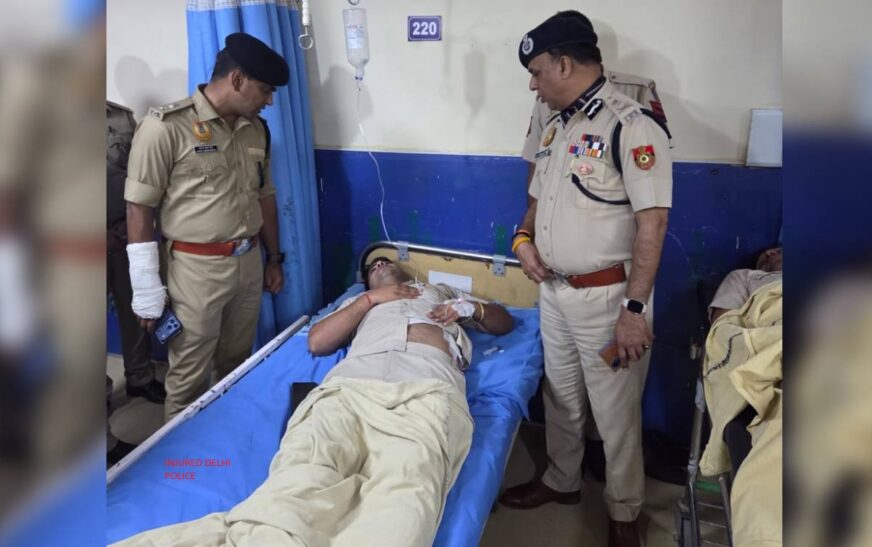
- First movement on ‘NEET’ paper leak was held, when original examination was cancelled, re-examination was over, and corrective actions for future NEET TESTS were taken by the MINISTRY. Hence—it was a motivated movement sponsored from outside on closed issue, which became violent, many Polices were beaten (200+), but Minister paid the price for his corrective actions on education syllabus on MUGHALS. Further—his resignation may have impact on BJP vote bank.
- Second movement had no basis as the cause is under review by JUDICIARY.
- And there is a call for MOCK Parliament, November movement… etc.
- The purpose of these protests were to create anarchy. Andolonjibis participated for that purpose as advised by their foreign masters.
- Prasant even said that Regime change is the target. Dipke said he is carrying orders only. Sourav has different parents listed at different records. Neha changed her statement. German resident DHRUV, who made Guest Appearance—said he has no connection with CJP, left via LONDON, where his protest show was hunted down by PRO-MODI Britishers. Wangchuk is “KAVI IN—KAVI OUT!” LoP left for Vietnam in the middle. Some observers say—USA stopped the supply of currency, and SKY-LANTERN of Protest collapsed and got grounded!
- In my opinion—SC is treating these troublemakers with “KIDS’-GLOVES” and preventing the GOI to take appropriate actions against them.
- GOI will be well within its rights to use limited force to break this movement, and make some preventive arrests.
- With chagrin, I opine that ‘Social sites’ has made GEN-Zee somewhat a soft target for Nuisance Makers.
References:-
- Bharatiya Nagarik Suraksha Sanhita—for Legal Position.
- Current newspapers on incidents.
- Image– Newspaper