
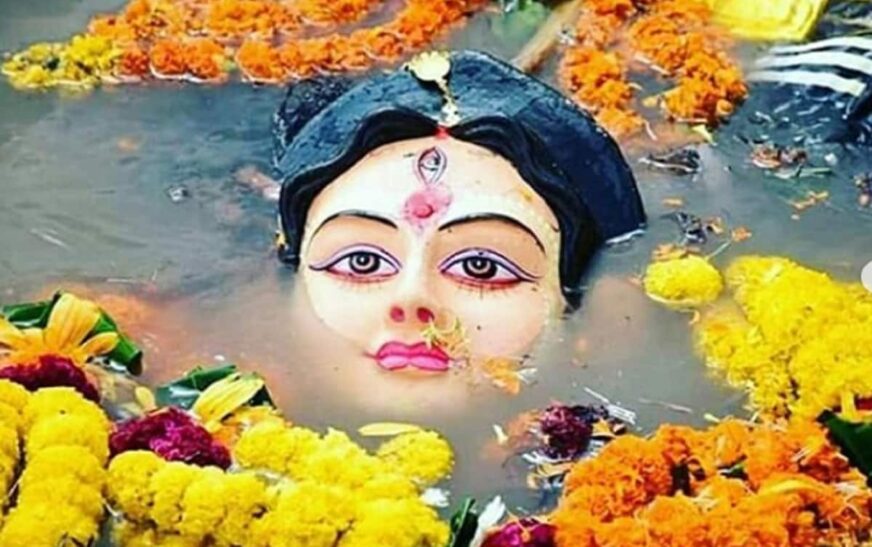
VISARJAN
SARASIJ MAJUMDER
VISARJAN is the Ritual cum Ceremonial farewell and dissolution of a Deity’s Form after a puja (Worship) in Sanatan Dharma . It also symbolizes the cycle of creation and return to nature, teaching detachment. Through Pran Pratishtha, a Formless Deity (a form of Godly Energy) is invited to occupy his/her place into an Idol. Visarjan respectfully returns that energy back to the infinite cosmos.
BISARJAN—in English, means ’Farewell, with a hidden intent of invitation for future’.
Core Spiritual Meanings:
- Cosmic Cycle: Life and the universe move through creation, preservation, and dissolution ( Srishti, Sthiti and Pralaya); Visarjan honors this natural sequence and rhythm.
- Detachment (Vairagya): It reminds devotees that physical forms are temporary (Anitya) and that we must learn to let it go without clinging to it.
- Returning to Elements: Clay idols made of earth dissolve back into water, symbolizing the reunion of the body with nature’s five elements.
What are the 5 types of Bera in Hinduism?
The Five Beras or Icons are specific to the Pancha Ratra Religion and are related to the Agamic temple tradition. Every Agama temple should have five icons as best practice.
- Dhruva- Bera also known as the mūla-bera– The main icon in the sanctum sanctorum which is of the immovable kind, constructed of granite stone and permanently fixed and installed for the preservation and nourishment of the community.
- Kautuka-Bera — the movable image made of 5 metals (pañca-loha) used for daily offerings and taking to the sacred tank.
- Snapana-Bera — the movable icon used for the daily bathing ceremony.
- Bali-Bera — icon used for the daily “bali” offerings of rice in the courtyard of the temple.
- Utsava-Bera — the icon which is taken out in procession on festivals.
If the financial state is permitting a sixth icon is added;—
- Śayana-Bera – the icon used for putting to rest at night
In practice few temples have all 5 or 6 – usually they have the Dhruva-Bera and the Utsava Bera which is placed in front of the Dhruva-Bera and it fulfills the function of the other 3 Beras – Kautuka, Snapana and Bali Beras.
The Pancha Ratra Agama (or Pāñcarātra) is a major body of authoritative Sanskrit scriptures and theistic texts in Hinduism that governs the philosophy, worship, and daily rituals of Vaishnavism or Shakta.
I will someday discuss about Shakta part. Shakta is a distinct, Goddess-centric Agama, they both deal heavily with Tantric and Agamic iconography.
Common Misconceptions
- Not Every Puja Needs Immersion: Visarjan is specifically performed for Temporary Festival Idols or Clay Murtis (like Lord Ganesha or Goddess Durga). Permanent idols installed in Home Altars or Temples (Aachala/Dhruva Beras) are not immersed; instead, a ritual of Upasana or sending the energy back is done internally, or daily worship continues.
- A Respectful Farewell: It is not an abandonment, which is why festivals like Ganesh Chaturthi conclude with joyful chants like “Ganpati Bappa Morya, ..
Temporary vs. Permanent Idols
Material: For temporary worship, Idols are made of perishable materials like natural clay, eco-friendly paper pulp, etc. Permanent Idols are sculpted from durable stone (like black granite), high-quality marble, or sacred metals (Panchaloha).
Energy Ritual:
Divine energy is invited into the form temporarily for a specific festival or ritual period. The Bera-deity’s consciousness is bound to the stone permanently through complex, layered consecration.
End of Puja:
Concludes with physical immersion (Visarjan) to dissolve the temporary form. For permanent Idol, it is maintained continuously with strict daily rituals, offerings, and prayers across generations.
How Pran Pratishtha Works
Pran Pratishtha translates literally to “establishing the life force” within an idol. Before this ceremony, an idol is considered a beautiful piece of art; after it, the object becomes a living manifestation (Archa Vigraha) of the divine.
The multi-step Vedic process generally includes:
- Adhivasa (Purification & Awakening): The idol is submerged in various elements over several days to purify the material and cushion it from sudden energy changes. This includes Jaladhivasa (water), Dhanyadhivasa (grains), and Ghrithadhivasa (ghee).
- Netra Unmeelan (Opening the Eyes): Using a golden needle or a small brush dipped in ghee and honey, the priest ritually opens the eyes of the deity from behind. A mirror is placed in front of the idol because the first gaze of the newly awakened deity is considered incredibly intense and powerful.
- Mantra Nyasa (Infusing Life): The priests touch different parts of the idol while chanting specific Vedic mantras. This acts like a cosmic charging process, drawing the formless divine energy out of the cosmos and establishing it inside the physical form.
- Maha Abhishek (The First Royal Bath): The newly awakened deity is bathed with sacred substances like milk, honey, yogurt, and sandalwood water before regular daily worship begins.
Maintaining a permanent temple idol (Achala Murti) requires strict adherence to ancient scriptural texts known as the Agama Shastras. Because a consecrated idol is treated as a living, royal entity, the rules governing a priest’s life and daily routine are incredibly rigorous to prevent Seva Dosha (faults or lapses in service) and to keep the deity’s energy intact.
The core rules and protocols a temple priest (Archaka or Pujari) must follow include:
- Strict Personal Purity & Discipline
- Meticulous Cleansing: Priests must wake up well before dawn (Brahma Muhurta), take a full bath, wear freshly washed, clean garments (usually unstitched cotton or silk), and apply sacred sectarian marks (like Tilak, Tripundra, or Holy Ash).
- Defilement Restrictions: A priest cannot enter the Garbhagriha (sanctum sanctorum) if they have touched a menstruating person, attended a funeral, or visited a cemetery without completing specialized purification rituals and baths.
- State of Mind: Ritual functions must never be performed in an angry, upset, or distracted mood. The mind must remain single-pointedly focused on the deity.
- Sanctum Sanctorum (Garbhagriha) Isolation
- Restricted Entry: No ordinary devotee, tourist, or uninitiated person is ever allowed to enter the inner sanctum or touch the permanent idol. Only the initiated priests who have undergone specific Deeksha (spiritual initiation) may touch the deity.
- No Secular Activity: Activities like sleeping, gossiping, eating personal meals, or using temple utensils for personal needs inside the sanctum are strictly forbidden.
- Precision in Daily Rituals (Shodashopachara)
- The Royal Routine: The priest must serve the deity through a fixed timeline of multiple pujas every day—typically at sunrise, noon, sunset, and midnight. The deity must be ritually woken up, bathed, dressed, fed, fanned, and put to sleep.
- Water & Vessel Protocol: Water for the deity’s bath (Abhishek) must be gathered fresh daily by the priest from a pure, designated source (like a temple pond or stream). It is divided into separate sacred brass or copper vessels for specific tasks (washing the feet, rinsing the mouth, and bathing).
- No Tasting or Smelling: Priests cannot smell the flowers or taste the food (Naivedyam) before it is offered to the deity. Doing so renders the offering unholy or “polluted” (Uchista).
- Continuous Operational Rules
- Punctuality: Food offerings and Aarti cannot be delayed. In the belief system, the living deity waits for meals and rest at specific planetary hours.
- Forbidden Materials: Priests must strictly avoid using forbidden flowers, iron utensils, or unprescribed materials during worship. Cotton clothing worn during the rituals must be washed fresh every single day.
COMPETITION:
I believe that the present practice of awarding “Best Idol,” “Best Pandal,” and “Best Illumination” etc. during Durga Puja should be modified. Why? For three reasons:
Judging is never perfect: Can the evaluation of art ever be truly objective? I can say with certainty that if you change the judges, the results will change entirely—which is precisely why different organizations often produce different outcomes. What is the consequence of this? Many deserving Puja committees—who spend the entire year working through the night, collecting donations, and worshipping the Goddess with deep devotion—return home disheartened when they fail to win an award. In place of pure devotion, a sense of suppressed pain takes root. Gradually, the obsession with “winning an award” begins to overshadow the original spirit of devotion and sincerity. A competition starts. This is bad.
And Ranking system shall be abolished.
Even if a set of JUDGES ( should be qualified), and different for selecting the ARTISAN, DECORATION & LIGHTING, THEME etc. may go through the Pandals— the result shall be withheld till Vijaya Dashami. Why? Read below.
- The danger of overcrowding: In any given city, there are thousands of Puja celebrations. If only ten of these are declared the “best,” what happens? The entire crowd surges toward those ten pandals, creating a serious risk of stampedes and other accidents. The Goddess visits every PANDALS; why, then, should the crowds be concentrated in only a few select locations?
- Hence not the product—but the person, or group of persons behind the creation shall be honored. They may even be RANKED.
MAY THE * DURGA PUJA* BE AN ACT OF DEVOTION, NOT A PURSUIT DRIVEN BY THE DESIRE TO WIN AN AWARD.
THE END