NAVA-RATRA [ NINE NIGHTS]
SARASIJ MAJUMDER
‘NAV-RATRA’ IS THE LARGEST ‘VRAT’ ( spiritual abstention from food, or certain kind of food) CUM Spiritual Festival of North India, observed by both, Male, and Female in the FULL MOON cycle of SHARAT RITU, known as DEVI PAKSHA, commencing immediately after ‘PITRIPAKSHA’.
If you want to taste the flavour of this “NAV-RATRA”—you must spend those days in a North Indian village.
I had that experience in 1985, when I spent last four days of NAVRATRA at Rajanpur, a Hindu-dominated village near Ayodhya, Uttar Pradesh. That village was one of my Colleague—Chandeshwar Prasad’s ancestral place, and he wanted me to accompany him, as he knew I sent my wife to Kolkata with my child along with my Father-in-Law and I was then living alone.
I owned a Maruti Van, and we drove to the village from my flat at Delhi, along with his wife and daughter.
It took close to 10 hours, with a half hour break in the middle. We started early.
In those HOLY days, a pious North Indian family takes Breakfast on Fruits, and sweets—then fasts whole day, take early ‘SATVIK’ dinner, and gather in a Ground where a stage was already erected, and Ramlila is performed by a ‘NOUTANKI’ group, along with a Singer-cum Orator, or others, who describes Ramlila, basically adopted from Poet Tulsidas.
The RAMAYAN, an EPIC cum HOLY BOOK, has seven Cantos(KANDOS).
- Ramlila Performances: In the days leading up to Dussehra, local artists and community groups stage Ramlila—a dramatic, multi-day theatrical retelling of the Ramayana.
Normally, RAMLILA on stage started with unknowingly killing of ‘SHRAVAN’ by King Dasharath, and getting a curse, that results in banishment of his eldest son, Rama with his wife, SITA and a younger brother, Lakshmana. Sita Haran (forceful elopement) by Ravana, king of Lanka beyond sea takes place. Ram gathers an army, builds a Bridge across sea, and the siege Lanka, and fight an epic battle leading to death of Ravana.
This tradition is recognized as an Intangible Cultural Heritage of Humanity by UNESCO.
In many temples in Indonesia, you will see above are painted as Frescoes.
- Kanyaka Puja (Navratras Conclusion): During the final days of Navratri leading up to Dussehra (such as Ashtami or Navami), families perform Kanyaka Puja, honoring and feeding young girls as manifestations of the divine feminine energy. In Bengal also, we have ‘KUMARI’ puja as a part of Durga Puja.
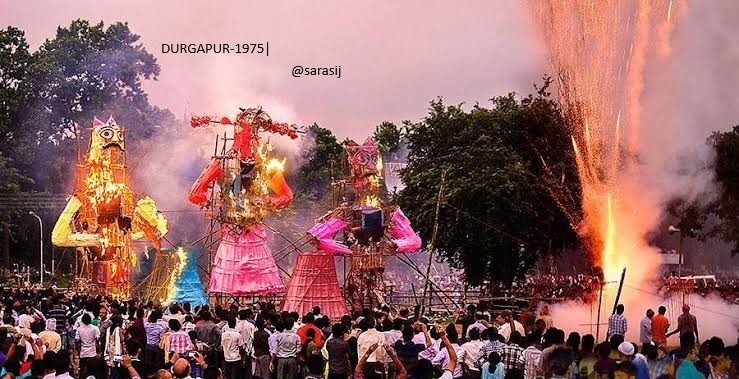
- Ravan Dahan (Effigy Burning): On the evening of Dussehra, giant, towering effigies of Ravana, his brother Kumbhakarna, and his son Meghnath—stuffed with firecrackers—are set ablaze in open grounds and public spaces. The spectacle is accompanied by loud cheers, fireworks, and a festive carnival atmosphere.
Actually—this symbolizes performing ‘FUNEREL’ of Ravana, and must be on later date, the principal members of his dynasty were added.
In the whole of EXCELLENT spiritual observance—this last act is a bit ‘VULGAR’—in my opinion. I discussed it at the end.
Demonified Ravan had some virtues also.
NAVRATRI FASTING FOODS (VRAT / FALAHAR)
During the nine days of Navratri, many people observe strict fasts. Grains like wheat and rice, onions, garlic, and regular table salt are replaced with specialized, non-grain ingredients and rock salt (sendha namak).
Kuttu and Singhara Puris: Deep-fried, puffed flatbreads made from buckwheat flour (kuttu) or water chestnut flour (singhara), usually paired with a spiced potato curry cooked without onions or garlic.
Sabudana Khichdi & Vada: Sago pearls (sabudana) tossed with roasted peanuts, green chilies, and potatoes, or shaped into crispy, deep-fried patties.
Sama ke Chawal ki Pulao: Barnyard millet cooked with light spices, acting as a direct replacement for traditional rice.
Sweets & Desserts
Fasting doesn’t mean skipping dessert; these sweets utilize milk, nuts, and root vegetables to maintain purity rules.
Makhana Kheer: A rich, creamy milk pudding made with puffed fox nuts (makhana), cardamom, and chopped dry fruits.
Sabu dana Kheer: A velvety dessert where translucent sago pearls are slow-cooked in sweetened milk.
Lauki / Halwa: Grated bottle gourd cooked down gently in ghee, milk, and sugar until rich and dense.
The Navami / Kanya Puja Prasad (The Transition)
On the final day of Navratri (Ashtami or Navami), the fast is officially broken by hosting young girls for Kanya Puja. A specific, highly traditional three-part prasad (sacred offering) is prepared:
Suji Ka Halwa: A rich, melt-in-your-mouth semolina pudding roasted in generous amounts of ghee.
Kala Chana: Dry, spiced black chickpeas cooked with cumin, ginger, and green chilies, offering a savory contrast to the halwa.
Poori: Fluffy, golden, deep-fried whole wheat flatbreads used to scoop up the chana and halwa.
Dussehra Celebratory Feasts
Once Dussehra arrives, all fasting restrictions are lifted. Families mark Vijayadashami with elaborate, indulgent meals and rich confectionery.
- Jalebi: While historically associated with Gujarat’s Fafda-Jalebi custom, buying giant, piping-hot, syrup-soaked jalebis on Dussehra morning has become a massive tradition across Uttar Pradesh, Delhi, and Bihar.
- Malpua: Rich, deep-fried pancakes soaked in saffron sugar syrup, boasting crisp edges and a soft, rabdi-like center.
- Kaali Dal & Shahi Paneer: Celebratory dinners feature heavy, comforting main courses like slow-cooked kaali dal (black urad lentils), rich paneer gravies, and fragrant vegetable pulaos served alongside naan or kachoris.
- Festive Mithai Boxes: Homes are flooded with classic gifting sweets like diamond-cut Kaju Katli, nutty Besan Ladoo, and soft Gulab Jamun to celebrate the victory of Lord Rama.
- Auspicious Beginnings: Dussehra is considered a highly auspicious day (Shubh Muhurat) in the North Indian calendar to start new business ventures, buy new vehicles, or make household investments.
Dussehra (also known as Vijayadashami) in North India marks the end of the nine-day Navratra festival and celebrates Lord Rama’s victory over the ten-headed demon king Ravana. It symbolizes the triumph of good over evil, virtue over sin, and light over darkness.
It also starts the official countdown—typically 20 days—to Diwali, when Lord Rama returned to Ayodhya.
Fairs and Carnivals (Melas): Large community fairs featuring food stalls, amusement rides, puppet shows, and local artisan markets spring up across towns and cities after NAVRATRA. For instance, regional showcases like the CII Chandigarh Fair often bridge the festive transition between Dussehra and Diwali.
ANECDOTES:
Key Details of Ravana’s Funeral:
- Lord Rama’s Instruction: Initially, Vibhishana hesitated to perform the funeral out of grief and anger toward Ravana’s misdeeds. Lord Rama gently convinced him, stating that enmity ends with death and that Ravana deserved proper respect as a fallen warrior and king. Rama even offered to perform the rites himself if Vibhishana refused.
- Vedic Rituals: Vibhishana, assisted by others, arranged a sacred pyre using sandalwood, perfumes, and appropriate Vedic rites, including ancestral oblations and ghee offerings.
- Family Presence: Mandodari and other women of the royal household also participated in mourning and offering water libations according to tradition.
Classical South Indian traditional Tamil Epic, Kambaramayanam— composed on 12th century, already recognized Ravana’s complex nuances (his unmatched devotion to Shiva, musical genius, and vast scholarship), but he was still ultimately treated as the Moral Antagonist. The explicit shift to treating him as a noble protagonist and political hero was a 20th-century phenomenon driven by anti-caste and regional politics by some Tamilian Leaders.
South India’s portrayal of Ravana as a virtuous king emerged heavily in the 1930s and 1940s, catalyzed by the rise of the modern Dravidian movement led by E.V. Ramasamy (Periyar)—to establish a separate South Indian Identity.
END