
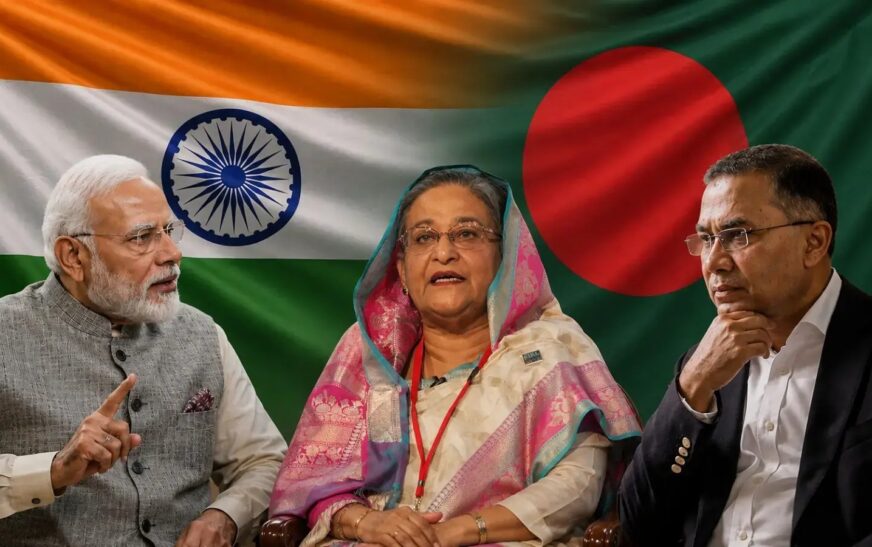
BANGLADESH CONUNDRUM
©SARASIJ MAJUMDER
“Minus Two”– Have that old phrase resurfaced in Bangladesh Politics? Specifically, the concept Hearing this phrase immediately recalls the events of January 11, 2007 (“1/11”), when the army-backed caretaker government attempted to remove both Sheikh Hasina and Khaleda Zia from the political landscape; both leaders were arrested at that time.
Drawing parallels with that history, an Indian media outlet, *Northeast News*, claims that Tarique Rahman could now be the next target. Since Sheikh Hasina’s government has already fallen, removing Tarique Rahman would effectively complete the “Minus Two” scenario.
This is a very serious matter.
Has a plan been set in motion to oust an elected government—regardless of how that election was conducted—and install a long-term PUPPET Administration by-passing Election? Or is a conspiracy narrative being constructed based on internal power struggles and various isolated incidents?
A report by Enayet Kabir, published in *Northeast News* on September 26, makes several claims citing an unnamed Bangladeshi intelligence source. I will discuss those claims shortly. But before that, let me mention that it is not just Bangladeshi intelligence source; a central intelligence officer —who is directly involved in monitoring Bangladesh—personally told a source known to me that another act of the power-seizure drama is set to unfold in Dhaka very soon.
Let us begin from here.
I will intersperse the claims published by *Northeast News*, and YOU TUBE (URL listed below) with information obtained from my own sources.
The first claim by *Northeast News* is that a meeting took place on September 22 and 23 at the residence of Major General Mahbubul Alam, the incumbent Vice-Chancellor of the Bangladesh University of Professionals. The report states that the attendees included Jamaat leader and ideologue Mahmudur Rahman, also the editor of the Bangladeshi newspaper *Amar Desh*, former military officers Abdullah Hil Aman Azmi and Hasinur Rahman, and—reportedly—an official from the Turkish intelligence agency.
The newspaper’s second claim is that two Pakistani military officials had previously visited Bangladesh secretly to hold meetings at various cantonments; the report’s sources suspected—and indeed identified them as ISI officers.
A third, even more significant claim suggests that plans are underway to establish a long-term, non-political, fundamentalist government in Bangladesh—orchestrated by Pakistan with the backing of the army and Jamaat-e-Islami, and funded by Turkey. The underlying objective is not only to seize control of Bangladesh but also to destabilize India. While *Northeast News* did not explicitly mention American involvement, some intelligence sources have indicated the participation of the USA—or, more precisely, the “Deep State” can’t be ruled out.
Regarding the potential leadership mentioned in the report—specifically, who will lead the new system currently taking shape—the names of Khalilur Rahman and Mahmudur Rahman have surfaced. My sources indicate that Muhammad Yunus is also involved in this plan.
Let us address the term “Minus-Two.” In 2007, this term referred to the objective of removing Bangladesh’s two principal female political leaders—Hasina and Khaleda—from the political arena. At that time, an army-backed caretaker government was in power amidst a state of emergency. However, the attempt to end the political careers of these two leaders ultimately failed.
The context has changed today. Khaleda Zia is no longer alive. Sheikh Hasina has been out of power in Bangladesh since August 2024 and is currently residing outside her country.
In the context of the report, the new “Minus-Two” concept implies the political exclusion of both the Sheikh family and the Zia family from Bangladeshi politics; this is the report’s political interpretation. Consider that the Awami League is an organization staunchly committed to the ideals of the Liberation War; consequently, pro-Pakistan factions sought to oust them—a fact that holds true. The BNP, however, is not exclusively pro-Liberation War in its orientation; it is something of a “khichuri” (mixed-bag) party, where pro-Liberation and pro-Pakistan elements coexist. BNP founder Ziaur Rahman did participate in the Liberation War, and he is also credited as the declarer of independence. Perhaps it is precisely for this reason—to sideline the BNP—that the “Minus-Two” formula has resurfaced.
The report also highlights Bangladesh’s diplomatic failure during the UN General Assembly session. It is a confirmed fact—and known to all—that Bangladesh’s Foreign Minister, Khalilur Rahman, served as the President of the 81st General Assembly. The report suggests that the meetings between Tarique Rahman and leaders from Turkey, Iran, and Pakistan were orchestrated specifically to court controversy around him.
More significantly, while the UN proceedings were underway, Yunus and Khalilur Rahman held series of parallel meetings in the vicinity of the UN headquarters.
Tarique Rahman’s visit to New York was a complete flop; the decision to restrict his movements to a specific perimeter—rather than granting him a standard visa—has also helped Yunus and Khalilur to execute their agenda.
Similarly, the report addresses the controversy surrounding the appointment of Tarique Rahman’s daughter, Zaima Rahman, to a legal position within the office of the General Assembly’s current President. This naturally raises questions regarding transparency: What were the qualifications and the selection process?
Who made the decision? From which fund is the salary will be paid? Is there a conflict of interest? These questions remain unanswered. Given the controversy surrounding this appointment, there is ample reason to believe that Khalilur Rahman—having already undermined the Prime Minister during the UN session—sought to offer a mere “compensation” by appointing Zaima Rahman to a post through an irregular process.
The report also questions the fact that the assembly hall was nearly empty during the Prime Minister’s speech and that the Secretary-General himself was absent from the podium. While low attendance or delegates stepping out can occur, the Secretary-General’s absence appears to have been entirely premeditated.
Attendance at major UN sessions fluctuates due to formalities and scheduling; the schedule itself is a crucial factor. It was Khalilur Rahman—serving simultaneously as the General Assembly President and Bangladesh’s Foreign Minister—who determined the specific time slot allocated for Tarique Rahman. He should have considered whether a request to reschedule the slot was warranted. For this reason, the incident is being described as a deliberate insult to the Prime Minister of Bangladesh.
The most sensitive aspect of the report concerns the army. Pressure is mounting on Army Chief General Waker-Uz-Zaman; there is talk of his replacement, and allegations of a rift within the military leadership have surfaced. Such internal tensions in the Government warrant a clarification from the Prime Minister—specifically from the ISPR. While the ISPR has not refuted the claims, the absence of a denial does not automatically validate them; conversely, silence is not proof of guilt either. However, allegations of factionalism within Bangladesh’s military leadership are nothing new, nor is the ISPR always silent on such matters.
Now, the question arises: why should we attach importance to such reports?
Even when evidence is limited, the reason is that the allegation itself is extremely serious. It raises grave concerns about whether certain individuals or groups are seeking to oust elected government in favor of a long-term, unelected fundamentalist regime.
At the same time, rumors of a military coup create instability within institutions and among the public. In either scenario, it is Bangladesh that suffers the damage. The government should clearly state whether the meeting in question—which was mentioned earlier—took place. Why was permission granted for the visit of foreign officials? What are the rules regarding Zaima Rahman’s appointment? Why are military authorities reluctant to disclose relevant information? Those named in these reports must be given an opportunity to present their side.
Credible answers emerge through the verification of documents and accountability. In my view, the true political significance of this report extends beyond the mere question of whether the allegations are true. It has reignited the old fear regarding who would seize power if the two major political parties of Bangladesh were sidelined.
The experience of 2007 reminds us that prolonged, unelected rule—ostensibly aimed at rectifying political flaws—does not strengthen democracy. I have stated in a previous ‘BLOG’ that to save Bangladesh from fundamentalist forces—such as Jamaat, as well as influences from Pakistan, Turkey, and the ‘DEEP STATE’—the Awami League must be brought back into mainstream politics. If the ban on them is removed and they are allowed to enter the political arena, these fundamentalist forces may be defeated. Tarique Rahman government face challenges regarding the economy, foreign policy, party unity, and political trust; only parliamentary politics can resolve these crises. This requires a collective political institution involving all parties; attempting to exclude anyone—just as Sheikh Hasina was sidelined—risks a return to the ‘Minus-Two’ formula, an agenda that is indeed being pursued.
Intelligence sources from Bangladesh have revealed, and whispered from elsewhere—that an attempt is underway to oust the government of Tarique Rahman through a meticulously designed scheme involving the military, mirroring the strategy used to topple Sheikh Hasina’s newly elected government and removed the Awami League from power in 2024.
It must be remembered that Islamist reactionary and Islamist fundamentalist forces have kept their sights on Bangladesh soon after its birth. Assassination of Bangabandhu was aimed at erasing the memory of the Liberation War— that was the initial manifestation of this goal, and such attempts have resurfaced repeatedly since then. Is something major about to happen soon? India, however, is more vigilant this time with BJP government on power.
Let me state this clearly: it will not be possible that Pakistan and Turkey will establish bases in Bangladesh with US assistance while India simply sits back like a helpless victim—it is not that simple.
And Russia left signal in BRICS that they are alive to the problem.
REFERENCES:
A September 26 Navbharat Times report, citing an intelligence-source account reported by Northeast News, alleges that a “Minus Two” plan is being hatched in Bangladesh. The report refers to alleged meetings in Dhaka on September 22–23 and claims that a possible long-term non-political government was discussed. It also alleges connections involving Turkey, Pakistan, and Bangladesh’s political and military circle.
https://nenews.in/neighbours/bangladesh-minus-two-formula-resurfaces-amid-alleged-plot-against-tarique-rahman-govt/65637/