
DRINKING ALCOHOL IN ANCIENT INDIA
SARASIJ MAJUMDER
‘MOD’ (or মদ in Bengali or অসমীয়া) meaning alcohol, wine, or liquor traces its genesis back to Sanskrit.
Etymological Lineage:
- Proto-Indo-European Root: Derived from the Proto-Indo-European root meh₂d-, meaning to drip, be wet, or be intoxicated.
- Sanskrit (Mada): In Sanskrit, the noun मद (mada) means intoxication, drunkenness, exhilaration, or rut (as in an elephant), coming from the verbal root mad (“to intoxicate, rejoice, or consume to the limit”).
- Modern Indo-Aryan Languages: The Sanskrit term MADA was borrowed into regional languages across South and Eastern India—including Assamese (MOD, মদ) and Bengali (MOD, মদ)—where it evolved into the everyday vernacular term for liquor, wine, or spirits.
Regional Context:
- In Assam and parts of Eastern India, MOD is widely used for general or country-made liquor, alongside traditional rice-beer and fermented brews like Xaj or Sai MOD (where SAI means ashes and MOD means liquor).
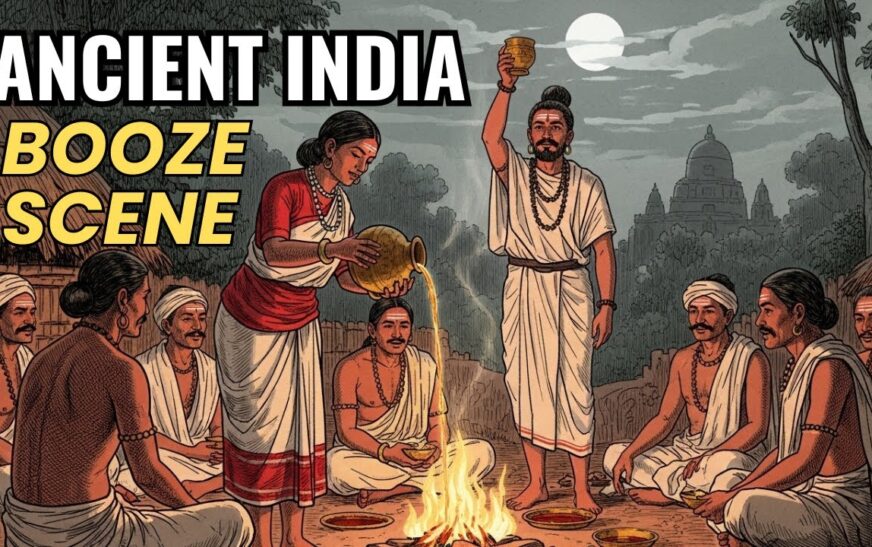
In Vedic period, MAD is known as “SURA”. It was first offered to ‘GOD’ before it was consumed. I will use that word in the ‘BLOG’ to mean MOD.
The Epic Mahabharata provides a well-organized account of ancient Indian social structure over various regions (*JANAPADAS*), social classes (*Varnas*), Tribes, and diverse professional groups. It is evident from this epic text that, within the social and economic landscape of ancient India, the community engaged in the production and sale of liquor was explicitly referred to as *Shaundika* (or *Saundika*). In several sections of the Mahabharata—notably in the *Sabha Parva*, *Vana Parva*, and *Shanti Parva*—there is a distinct mention of this professional group alongside others present in the society of that era. For instance, in a passage within the *Shanti Parva*, the *Shaundikas* are mentioned alongside individuals engaged in various other professions of that time.
“-शौण्डिकाः कारुकाश्चैव नटाश्चैव महीपते।
सर्व एव ते राजन् पूज्याः स्वकर्मणि स्थिताः॥“
English Translation:
“O Lord of the Earth, distillers, artisans, and actors alike—all of them, O King, are worthy of respect, provided they remain steadfast in their own duties.”
Conceptual Highlights:
- Equal Dignity of Labor: This verse from the Shanti Parva of the Mahabharata emphasizes that social respect is not dictated by the perceived status of a profession, but by the dedication one brings to it.
- The Three Examples: Bhishma purposefully picks professions that were historically considered common or lower-status (wine-makers, manual artisans, and performers) to explicitly state that they deserve the exact same honor as anyone else.
- The Universal Condition (Sva-karmaṇi sthitāḥ): The ultimate measure of a person’s worthiness or righteousness is their integrity, honesty, and steadfastness in fulfilling their social and professional responsibilities.
Then, we can conclude that in Vedic period, and later—‘Dignity of Labour’ was in vogue —respected, and practiced in Bharat.
WE HAVE NOT LEARNED IT FROM EUROPEANS—WHO WERE THEN POSSIBLY MUCH BEHIND IN CIVILIZATION!
According to historians, the presence of *Shaundikas* (purveyors of liquor) within the economic structure of India during the era of the Mahabharata indicates that there was an established market and a prevalent culture surrounding the consumption and trade of alcoholic beverages in that society. In ancient India, *Shaundikas* practiced their profession independently. Furthermore, ancient literature refers to specific locations or establishments designated for those who consumed such drinks. Although the *SHASTRAS* (scriptural texts) and the *SMRITIS* (legal/ethical codes) of that period often imposed moral restrictions on the consumption and sale of alcohol, the Mahabharata—reflecting a more liberal perspective—regarded every professional group, dedicated to its own specific craft, as equally vital to the sustenance of society. This is because all such groups were integral components of the rural and urban economies of that time.
BUDDHISM & ITS INFLUENCE:
The Origins and Early Buddhism (5th Century BCE)
- Founding: Buddhism began in the ancient Magadha region of India (modern-day Bihar) with the life and teachings of Siddhārtha Gautama, known as the Buddha, who lived roughly between the 6th and 5th centuries BCE.
- Nature: During this “pre-sectarian” era, the teachings were transmitted orally by the monastic community (Sangha).
Sectarian Expansion and The Mauryan Era (3rd Century BCE to 1st Century BCE):
- Imperial Patronage: Emperor Ashoka of the Mauryan Empire converted to Buddhism in the 3rd century BCE. He formalized its principles and sent royal missions that exported the religion beyond India to Sri Lanka, Central Asia, and parts of the Mediterranean world.
In this period, we first find that *Shaundikas* are looked down upon, along with their trade, and drinking is not considered socially acceptable.
In ancient Buddhist literature—particularly the Pali Tripitaka, the Jataka tales, and the Mahayana Sutras—as well as in ancient Jain literature, such as the discourses of Mahavira and the Agama Sutras, one finds compelling accounts regarding the profession of those who manufactured and sold liquor, their social standing, and the detrimental effects of alcohol consumption. The Buddhist Jataka tales contain explicit references to liquor manufacturers—known as *surakara* or *surika*—alongside various other artisans and merchants of that era. These texts primarily highlight the adverse consequences of consuming alcohol. For instance, in the *Kumbha Jataka* (Jataka No. 512), the deity Indra descends to the mortal realm carrying a vessel of liquor to demonstrate its harmful nature to ordinary people and merchants. The narrative illustrates how alcohol consumption can reduce wealthy families to destitution, cause individuals to lose their dignity and behave like beasts, and foster an increase in criminal tendencies within society. Furthermore, the Jataka literature frequently mentions the unscrupulous practices of dishonest liquor sellers; for example, the *Punnapati Jataka* depicts the act of deceiving customers by adulterating liquor with poison or other harmful substances—a practice portrayed as a form of criminal activity during that period. It is evident from these accounts that both Buddhism and Jainism in ancient India—placing the utmost importance on non-violence (*ahimsa*) and moral purity—regarded the production and sale of liquor as a deeply reprehensible or sinful occupation. It is worth noting that among the ‘Five Precepts’ (*Pancha-shila*)—which Gautama Buddha himself made mandatory for his followers—the fifth precept is:
“सुरामेरयमज्जपमादट्ठाना वेरमणीसिक्खापदं समादियामि।” (The original script of this precept is written in the Pali language).
—that is, to abstain from consuming any intoxicating substances. Furthermore, within the Buddhist ‘Noble Eightfold Path,’ the principle of ‘Right Livelihood’ (*Samma-ajiva*) explicitly prohibits five types of trade; among these is the trade in intoxicants or poisons (*majja-vanijja*). Consequently, in ancient Buddhist society, the profession of a liquor merchant (*Shaundika*) was regarded as highly inferior and detrimental—both from a social and a moral perspective. Similarly, in Jainism, the teachings of Mahavira and the *Agama* literature discuss the lives of those who produced and sold alcohol in detail. A core pillar of Jainism has always been the practice of strict non-violence (*ahimsa*). Since the process of brewing alcohol in ancient times inevitably led to the destruction of countless microorganisms, insects, and small living creatures, ancient Jain scriptures condemned the production and consumption of alcohol as a grave sin (*maha-papa*). For Jain followers (*Shravakas*), engaging in the trade or sale of alcohol was strictly forbidden. As a result, those involved in this profession were often viewed as marginalized or distinct from the moral mainstream of society—a perspective shared by both Jain and Buddhist traditions. Notably, in ancient Buddhist tantric and literary circles—which laid the foundations for the later *Vajrayana* tradition and the *Charyapada*—the figure of the *sundini* (a woman who brews or sells alcohol) was frequently employed as a metaphor. In the context of ancient Buddhist yogic literature, even the person who served liquor in a tavern—in the ordinary sense of the term—was viewed as a symbol of consciousness or wisdom, possessing the power to either delude or influence the mind of a spiritual practitioner.
MOURYA PERIOD (322 BCE to 185 BCE):
EARLY PART:
But–The best of ancient Indian political science and economics written by आचार्य चाणक्य or कौटिल्म् From the classical historical text Arthashastra, the administrative structure, revenue collection and an unprecedented argument for economic control is found. And this book contains a chapter– Sura Dhyaksha Prakaran, is about running a shop or a pawn shop. Excise duty (অবক্ষয় or শুল্ক), and detailed rules of state control are described. It was esxisting. It is known from this book that in the Mourya Empire, the production and sale of Sura or Mad was not free or there was no open trade. The state then directly exercised strict supervision over this industry; And for this purpose, a high-ranking government official named ‘Superintendent of Liquor’ was appointed. In India during the British Colonial era, merchants or traders opened independent liquor shops wherever they wanted. But in this era, this business was conducted according to the prescribed rules subject to the permission and license of the government. Was managed and controlled. Therefore, in his book, Sura Daksha will be able to control the shops and traders.
सुरूपं सूचितं वापि क्रयेऽविक्रयविक्रये।
शौण्डिकानां गृहप्रान्ते राजमार्गे च संस्थितम्॥
That is, the place of buying and selling of the sellers should be beautiful and clean in appearance. and place must be clearly marked; It will be installed on the boundary of the house or along the main road.
Apart from this, he also said that, Sura Daksha, the liquor shops in the entire district shall be orderly. Control them so that discipline is always maintained. The merchants would not be able to sell liquor secretly without the permission of the king. And their shops are at fixed places, limited quantities, and fixed charges (as per the era). This will have to be managed by paying tax (tax) on the fifth part of the total sales. Moreover, so that brothels or wine shops do not become dens of crime, the state should also Keep a close eye. That’s why gambling, thieves or suspicious people couldn’t gathered in such shops during that time. They were strictly prohibited. On the other hand, to maintain the standards of women and prevent corruption, the political system of that era was created by Sura Daksha. And if you sell low quality or health injurious liquor then you will be punished severely. There was provision for financial penalty or punishment. Even in the society of that time, high-class, elite people or noble people were ruled under the policies. There were various social restrictions on the sale of liquor to such persons. Safety rules had to be followed.
According to historians, this description of Artha shastra clearly proves that in ancient Indian Society the Shondaik community was not just a professional group; Rather, they were a significant component of the empire’s internal economy and state treasury. Controlled and enriched the share. And only then the state did not completely ban drinking alcohol; Rather, it was turned into a profitable source of revenue through strict control.
So, we can conclude—treating *Shaundikas* as a lower caste started with progress of Buddhism.
Further degradation started from the period of ‘Manusmriti’—
In the 4th chapter of MANUSANHITA, there is a specific mention of the word ‘शौण्डिक’ in the first place, where This word was applied in the law regarding food consumption and prohibition of professionals. It can be seen-
तक्षणोऽन्नं कांस्यकारस्य शौण्डिकस्याततयिनश्च च।
बध्यस्य वार्धुषेश्चैव वर्ज्यमन्नं मनीषिभिः॥
—-Manusanhita/4-84.
English Translation: “The food of a carpenter, of a metalworker, of a liquor distiller, of a deadly attacker (or executioner), of a man condemned to death, and of a usurer (exploitative moneylender) must be avoided by wise men.”
Hence—we can see, that “VARNA” system is replaced by what was defined by Britishers as “CASTE SYSTEM” from Manu. That was the GENESIS of UPPER CASTE, and LOWER CASTE.
The highly developed free society that existed during Vedic period, practicing ‘Sanatan Dhrma‘, first degraded to narrow conservatism under the influence of BUDDHISM, then further degraded when the ‘DHARMA’ was bonded by MANUSAMHITA.