VLADIMIR ILLYCH ULIANOF
SARASIJ MAJUMDER
VLADIMIR ILLYCH ULIANOF’S MUSK WAS ‘LENIN’! And during my student years, he was one of my Heroes! I bought and read his complete works.
In this ‘BLOG’, I will de-mythify some known well circulated half-truths, and un-truths about him.
TRUTH ABOUT NOVEMBER REVOLUTION:
- Lenin did not oust the Tsar from power. The Tsar fell in February 1917; at that time, Lenin was living his absconded life in Germany. CHECK AUTHENTIC HISTORY BOOKS.
- The Tsar fell due to imminent defeat in World War I at the hand of Germany and financial crisis; he simply abdicated.
- In April 1917, Lenin returned to the country, hiding on a German train IN FULL SECRECY.
- Subsequently, the interim government changed once in July and a second time in October. It was during this second change that the Bolsheviks came to power—merely the result of a factional struggle. Lenin’s predecessor, Alexander Kerensky, lived for another 52 years; he did not step aside because of a revolution.
So, the Tsar was not Lenin’s predecessor. Kerensky was Lenin’s predecessor. Kerensky’s predecessor was Georgy Lvov, and Lvov’s predecessor was Tsar Nicholas II.
Then who removed Nicholas?
This involves one of the greatest historical distortions—one that will shock you. Upon returning after a defeat by Germany in World War I, Nicholas abdicated voluntarily; he first designated his son and later his brother to succeed him. When his brother refused to take the throne, a Provisional Government was formed. Although Nicholas wished to go to Britain or France, opposition from leftists in those countries advised Kerensky to place the family in a governor’s residence in August. Later, after Lenin assumed power, the entire family was deceived and executed early the following year; the suddenness of the execution took rest of the family, and people in RUSSIA completely by surprise.
From Jyoti Basu, Buddhadeb Bhattacharya, and Promode Dasgupta to Shibdas Ghosh and Charu Majumdar—they all lied. The history syllabus of Kolkata, Jadavpur, and Presidency universities lied, as did the history textbooks for the Madhyamik and Higher Secondary examinations.
So, in conclusion, here are the two biggest lies:
- In March 1917, a conflict arose between Lenin and the Tsar; however, at that time, Lenin was staying at a military camp in Germany—Russia’s primary adversary in World War I.
- Regarding the so-called “November Revolution,” the Tsar was under house arrest at a governor’s residence at that time, while Kerensky held power.
The reality is that since the Tsar’s downfall was orchestrated by Germany—and because Germany installed Lenin in power as their puppet—Lenin handed over vast swathes of Russian territory and five million citizens to Germany as the price for his position. This transaction was formalized through the Treaty of Brest-Litovsk in 1918.
The Treaty of Brest-Litovsk was a separate peace agreement signed on March 3, 1918, between Russia’s new Bolshevik government and the Central Powers (Germany, Austria-Hungary, the Ottoman Empire, and Bulgaria), officially ending Russia’s participation in World War I.
Key Facts and Terms–Location: Signed in Brest-Litovsk (modern-day Brest, Belarus).
Massive Territorial Loss: Russia surrendered roughly 30% of its population, 32% of its arable agricultural land, and over 50% of its heavy industrial and coal mining base.
Independence Recognized: Russia relinquished claims to Finland, the Baltic states (Estonia, Latvia, and Lithuania), parts of Poland, and recognized the independence of Ukraine.
Financial Penalties: Russia agreed to pay 6 billion German gold marks in reparations.
Consequences–German Advantage: Allowed Germany to pull troops from the Eastern Front to launch a final, massive offensive on the Western Front.
Internal Turmoil: Sparked deep political division inside Russia, fracturing the Bolshevik coalition and helping ignite the brutal Russian Civil War between the Reds and the Whites.
Short-Lived: The treaty became completely void just eight months later in November 1918, following Germany’s military defeat and the general armistice.
Lenin and ‘Neribad’ (নেড়ীবাদ):
The Nature of ‘Neribad’ which is Lenin’s Ideological Hypocrisy:
Labeling Vladimir Lenin’s political philosophy and its practical application as ‘Neribad’ (a term implying a low-level canine-like, predatory nature) is hardly an exaggeration. This is because the true nature of a philosophy that speaks of equality and rights—yet, like a starving street dog, snatches away all fundamental human rights to forge a brutal state apparatus—bears a striking resemblance to such a concept. Throughout his life, Lenin advocated for the liberation of exploited workers and peasants; however, upon assuming power, he himself weighed down upon them like a crushing boulder, acting as their greatest oppressor. The chasm between his promises and his actions stands as one of history’s most significant examples of political hypocrisy.
A Harsh Critique of the Philosophy: Dictatorship Disguised as Communism:
The most significant flaw in Lenin’s philosophy (Leninism) is its ‘Vanguard Party’ theory. He believed that ordinary workers were incapable of carrying out a revolution on their own and required a handful of professional intellectuals to lead them. Fundamentally, this theory disregards the independent thinking capacity of the working class—the ‘Proletariat’. Under the guise of ‘Democratic Centralism,’ he instituted a system where decisions made by the party’s top leadership were final, leaving ordinary cadres and the common people with no right to express their opinions. By distorting Marxism, this system effectively created a new, opportunistic elite ruling class –the *Nomenklatura*.
The term needs some more clarifications.
NOMENKLATURA:
Nomenklatura refers to the elite bureaucratic ruling class in the former Soviet Union and other communist countries, as well as the Communist Party system. They approve appointments to key positions.
Core Definition–The Ruling Elite: A privileged social class of high-ranking administrators, government officials, and managers who ran industry, education, and government.
The Appointment System: A political patronage list of leadership positions is vetted, politically reliable people approved by the Communist Party to fill them.
Origin: The Russian word ‘NOMENKLATURA’, is derived from Latin meaning a “list of names”.
Key Features–Party Control: Only individuals vetted and approved by the Communist Party could hold these influential jobs.
Special Privileges: Members enjoyed major perks unavailable to the public, such as luxury apartments, special shops, better healthcare clinics, and priority university admission for their children. They spent weekend and holidays in “DHACHAS”!
Broader Usage: Today, the word can describe any entrenched, privileged ruling class or elite group that monopolizes power. For example—in India, INC’s—Gandhis & BADRA the DAMAD, and in erstwhile TMC—Mamata’s Clan were ‘NOMENKLATURA’.
The Naked Face of Hypocrisy: Consolidation of Power and State Terror.
Lenin’s ideological hypocrisy was glaringly evident at every step of his rule:
The Murder of Democracy: When the Bolsheviks lost the free elections for the Constituent Assembly in November 1917, Lenin used military force to permanently dissolve that elected body.
Suppression of Workers’ Uprisings: Lenin ruthlessly slaughtered the sailors of the Kronstadt naval base—who had originally helped him rise to power—when they took to the streets in 1921 demanding genuine Soviet democracy.
Red Terror: He established a secret police force known as the ‘Cheka’ to suppress dissenters; this force killed millions of innocent people without trial.
Exploitation of Peasants: Under the policy of ‘War Communism,’ grain produced by peasants was forcibly confiscated, leading to a devastating famine in Russia during 1921–1922.
Dramatic Downfall: Communist Frankenstein Monster’s Tragic End:
Lenin’s political and physical decline was both dramatic and tragic.
Lenin’s illness at least mimicked the progression of syphilis, afflicting him for months with occasional seizures and excruciating headaches, as well as bouts of nausea, sleeplessness, and partial paralysis. Penicillin was yet to be discovered.
Following 1922, he suffered a series of strokes that left him completely paralyzed.
Control over the authoritarian system he had created passed into the hands of Joseph Stalin. During his final days, while bedridden, Lenin realized just how dangerous Stalin was, yet his physical incapacitation left him powerless to act. The very monster of dictatorship he had unleashed ultimately condemned and devoured him to a helpless, voiceless death.
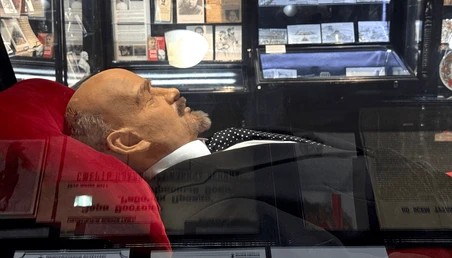
And after that—a Mausoleum is established in his name, where his body is ‘Mummified’ (Embalmed) for public view! The Mummified body requires yearly maintenance.
Address: Lenin’s Mausoleum on Red Square in Moscow.
I visited the Mausoleum in 1997.
Bibliography (Some References):
Pipes, Richard. The Russian Revolution. Vintage Books, 1991.
Service, Robert. Lenin: A Biography. Belknap Press, 2000.
Volkogonov, Dmitri. Lenin: A New Biography. Free Press, 1994.
Figes, Orlando. A People’s Tragedy: The Russian Revolution: 1891-1924. Penguin Books, 1998.