
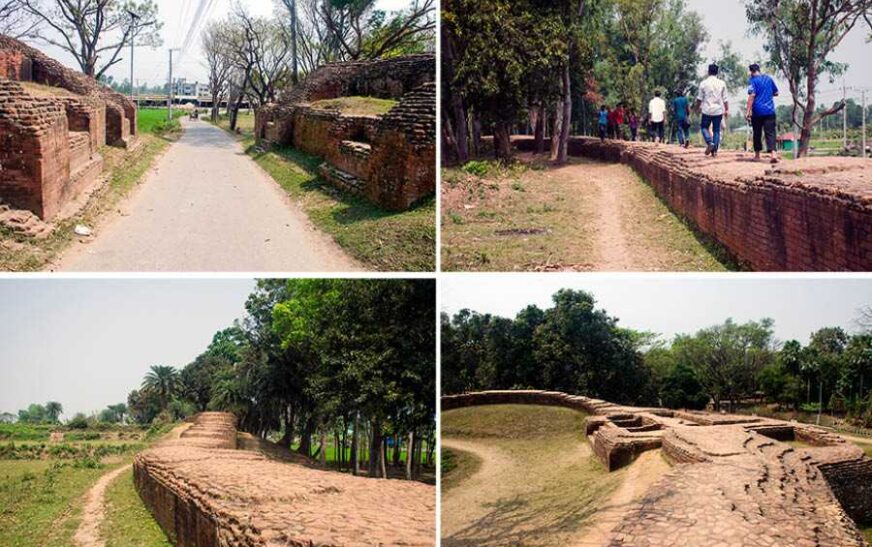
CAPITALS OF BANGA (BENGAL)
PART—1||3rd Century BCE
SARASIJ MAJUMDER
MAHASTHANGARH (PUNDRANAGARA): (From 3rd Century BCE)
The oldest capital city in Bengal (located in present Bangladesh), named MAHASTHANGARH / PUNDRANAGARA, was serving as the provincial capital during the Maurya and Gupta empires. And later it became Capital City, having a continuous history of playing very important role over 1,500 years, from Ancient to Early Medieval Period.
No other City, or Capital ruled so long a period in BANGA. History I was taught in school just mentioned its name only.
Mahasthangarh, historically known as Pundranagara, is the oldest urban archaeological site discovered in the entire Bengal region. Located in the Bogura District of modern-day Bangladesh, it served as the prominent capital city of the ancient Pundravardhana region for over a millennium.
Historical Milestones & Dynasties: The Mauryan Era (3rd Century BCE):
A landmark limestone slab found at the site—the famous Mahasthan Brahmi Inscription—confirms that Pundranagara was a highly prosperous provincial capital under the Maurya Empire. The inscription records an imperial administrative order issuing famine relief (mustard and sesame seeds) from the royal granaries to the local population.
Gupta & Pala Dynasties (4th–12th Century CE): Under the Guptas, it remained a vital administrative hub. Later, during the Pala Empire, it evolved into a massive epicenter for Buddhist philosophy and learning, heavily patronized by the Pala monarchs who built numerous monasteries and stupas.
Famous Accounts: The legendary 7th-century Chinese scholar-monk Xuanzang (Hiuen Tsang) visited Pundranagara, documenting its massive monastic communities and thriving economy in his travelogues.
Strategic Geography–Natural Elevation: The city was strategically built on the red soil of the Barind Tract (Barindra), standing nearly 36 meters above sea level. This elevation kept the citadel safe from the severe annual seasonal floods that affected the lower Bengal delta.
The Karatoya River: In antiquity, the adjacent Karatoya River was a massive trade artery, reportedly wider than the Ganges. It connected Pundranagara directly to major ancient Indian capitals like Pataliputra (modern Patna).
Archaeological Structure: The Citadel & Moat:
The heart of the site is a massive fortified oblong citadel measuring roughly 1,525 meters by 1,370 meters, defended by thick mud and brick ramparts alongside a deep protective moat.
ARCHEOLOGICAL EVIDENCE:
Excavations at the Mahasthangarh archaeological site have revealed a remarkable timeline of civilizational layers. Joint excavation projects, including a major Bangladesh-France joint venture, have dug down nearly 17 meters to virgin soil. This effort uncovered 18 distinct archaeological layers that map out the continuous occupation of the city from the 5th Century BCE up to the 12th Century CE.
The 7 Stratigraphic Eras of Mahasthangarh Excavation data highlights how the city evolved across seven distinct historical chapters:
Pre-Mauryan & Mauryan (5th–3rd Century BCE): Characterized by Northern Black Polished Ware, punch-marked silver and copper coins, and the landmark Brahmi inscription.
Sunga Era (2nd–1st Century BCE): Marked by highly sophisticated Sunga terracotta plaques depicting standard deities, mother-and-child figures, and floral motifs.
Kushan Era (1st–3rd Century CE): Yielded specialized pottery styles and Kushan-style coins pointing to far-reaching economic ties.
Gupta Era (4th–6th Century CE): Uncovered grand brick structures, expansive pavements, and sophisticated gold-ornament moulds indicating a wealthy bureaucratic class.
Late Gupta / King Shashanka Era (6th–7th Century CE): Highly defined by defensive restorations and major structural expansions of the main citadel walls.
Pala Empire Era (8th–11th Century CE): A massive boom in Buddhist infrastructure, resulting in monolithic monasteries, shrines, and bronze castings of Ganesha and Garuda.
Sena & Pre-Islamic Era (11th–13th Century CE): Structural shifts to Hindu temples, later followed by early Islamic additions such as a 15-domed mosque complex at the Mankalir Dhap mound.
Prominent Mounds and Architectural Wonders: The historic metropolis expand across an 8-to-9-kilometer radius outside the core fortress walls, concealing hundreds of distinct archaeological structures:
Archaeological Mound / Site Description & Key Structural Discoveries:
Gokul Medh (Behular Basar Ghar): Located 3 km south of the citadel, it is a magnificent 13-metre-tall terraced podium containing 172 rectangular blind cells built to support a massive, now-lost Buddhist stupa.
Govinda Bhita: Positioned right on the bend of the Karatoya River, this temple site features distinct, overlapping structural foundations from the 3rd and 7th centuries CE.
Bairagir Bhita: A temple complex built and rebuilt across four eras (4th to 11th centuries CE), yielding two beautifully sculpted sandstone pillars.
Khodar Pathar Bhita: Literally meaning “The Mound of Allah’s Stone,” it famously yielded massive decorative stone blocks carved with images of a transcendent Buddha surrounded by devotees.
Parasuramer Prasad: A palace complex showing three tiers of life: a 18th-century structure over an early Islamic settlement, which sat directly on top of an 8th-century Pala-era Vishnu temple base.
Economic Powerhouse of Ancient India: Ancient texts provide clear clues about why the city was so highly valued. Kautilya’s famous 4th-century BCE treatise, the Artha Shastra, makes specific mention of Paundrika, a rare, luxury wild silk, alongside Dukula, an incredibly fine-quality cotton cloth, both manufactured exclusively in the Pundra region.
The 11th-century folktale collection: ‘KATHASARITSAGARA’ by Somadeva also details a major, highly active imperial highway running directly from Pundranagara to Pataliputra (modern-day Patna, Bihar), cementing the city’s status as the major trading gateway out to the Bay of Bengal.
VASHU VIHARA MONASTERY COMPLEX:
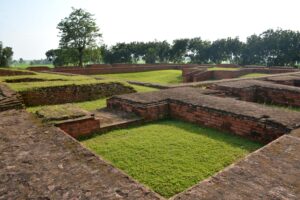
The ancient Vashu Vihara (also spelled Vasu Bihar or Bhasu Vihara), locally known as Narapatir Dhap (Mound of the King), is one of the most prominent academic and monastic sites of early Bengal. Located just 6 kilometers west of the Mahasthangarh citadel on the west bank of the Nagar River, it functions as an extensive suburb of the ancient capital.
The site gained international fame because it was identified as the “Po-shi-po” monastery meticulously documented by the Chinese pilgrim-monk Xuanzang (Hiuen Tsang) during his travels in the 7th century CE.
Xuanzang’s Eye-Witness Account: When Xuanzang visited the Pundravardhana region between 639 and 645 CE, Vashu Vihara was at its zenith. In his travelogues, he described it as a sprawling, grand institute hosting over 700 Buddhist monks belonging to the Mahayana school. According to Xuanzang, the complex was a world-class Centre of academic excellence that attracted renowned scholars from across East Asia. He noted that the local monks shared a tradition stating that Gautama Buddha himself had preached at this very location, and that the Mauryan Emperor Ashoka later constructed a monumental stupa nearby to commemorate the event.
The Structural Layout: Systematic archaeological excavations—begun in 1973 by Dr Harun-or-Rashid and continuing into recent phases—have uncovered the precise architectural blueprints of the complex:
Monastery 1 (The Large Vihara): A massive quadrangular burnt-brick structure measuring roughly 148 meters by 139 meters. It features 26 monastic cells arranged around a spacious central open courtyard. Its eastern entrance is incredibly grand, flanked by two sturdy guardrooms and an elegant, pillared entrance hall.
Monastery 2 (The Small Vihara): Lying just northeast of the larger complex, this structure mirrors its layout but is more compact, housing 30 slightly smaller residential cells wrapped around a central plaza that archaeologists believe functioned as an open-air lecture hall or auditorium.
The Semi-Cruciform Shrine: Just behind the residential quarters lie the foundations of a massive temple built in a partial cruciform layout, showcasing sophisticated step-back brick architecture characteristic of the late Gupta and early Pala Dynasty styles.
Major Archaeological Discoveries: Excavation layers have yielded nearly 800 significant historical artifacts that offer a window into monastic life over a thousand years ago:
The 18 Imperial Clay Seals: The most significant epigraphic find includes a cache of 18 ancient terracotta seals. Most bear inscriptions belonging to the Pala Dynasty (specifically associated with the 8th-century ruler Dharmapala), which officially confirms royal state patronage of the university.
Buddha Statues in Trance: Excavations have unearthed beautiful bronze and terracotta statues, most notably a rare sculpture of a Buddha in a deep meditative trance, alongside figures of Ganesha and other contemporary deities.
Artistic Architecture: Thousands of intricately carved ornamental bricks and terracotta plaques depicting standard flora, fauna, and human lifestyles have been recovered, many of which are housed in the nearby ‘Mahasthan Archaeological Museum’.
HOW TO VISIT:
The nearest local sub-district town from the Vasu Bihar ruins is Shibganj, while the nearest major commercial city and district headquarters is Bogura. One of my cousin brothers was staying in BOGURA, and teaching in the Bogura Jilla (government) school. I visited this place in winter—1973, on his advice, as a part of my Bangladesh trip. He was my ‘GUIDE’.
REFERENCE: Some information is available in public domain. Balance is available in the book I referred below.
For Further Reading:
MAHASTHANGARH: MAHASTHANGARH AND ITS HISTORY- by MD ROBIN HOSSAIN (Author) Format: Kindle Edition. Free for reading. I read. You can buy also.