
EXTRADITION ACHIEVED BY GOI/NDA
SARASIJ MAJUMDER
How many Criminals are extradited by GOI in last 10 years??
The Government of India (GOI) has brought back 274 fugitive criminals from 36 countries through cumulative repatriation methods (including extradition and deportation). According to data released by the Ministry of Home Affairs (MHA) and the Ministry of External Affairs (MEA), India’s tracking and repatriation of fugitives have seen a significant increase under an integrated, technology-driven multi-agency framework. Annual Breakdown of Fugitives Brought Back (2019–2026) Out of the overall numbers, the year-wise data of repatriated fugitives highlights a major push in recent years:
2026 (Till July): 45 fugitives
2025: 70 fugitives (Highest recorded in a single year)
2024: 43 fugitives || 2023: 37 fugitives ||}2022: 40 fugitives
2021: 23 fugitives ||2020: 7 fugitives ||2019: 9 fugitives
Categorization by Offence: The 274 criminals brought back since 2019 span multiple legal and criminal categories:
Murder, Robbery & Violent Crimes: 62 offenders
Sexual Offences (including POCSO): 53 offenders
Other Criminal Cases: 45 offenders
Organized Crime / Gangsters: 42 offenders
Human Trafficking: 18 offenders
Terrorism & Anti-National Activities: 17 offenders
Narcotics & Drug Trafficking: 16 offenders
Smuggling & Fake Currency: 12 offenders
Financial Fraud & Economic Crimes: 9 offenders
Pure Extradition Requests vs. Overall Returns: While “bringing back” includes multiple legal pathways (such as deportations or deport-on-arrival), strict formal legal extraditions take longer due to Foreign Judicial Processes. According to an official parliamentary response by the Ministry of External Affairs (MEA), India sent 137 formal extradition requests globally, out of which 134 were accepted by foreign regimes, resulting in 25 successful pure legal extraditions specifically finalized.
Currently, India maintains operational formal Extradition Treaties with 48 countries and designated Extradition Arrangements with 12 nations.
The Government of India (GOI) completely overhauled its approach to tracking overseas fugitives, resulting in 274 fugitive criminals being brought back from 36 countries. This represents a near ten-fold increase compared to previous decades.
For context, between 2004 and 2013, India managed to secure the return of only AVERAGE FOUR FUGITIVES (4) annually.
Under the Ministry of Home Affairs (MHA), the process was escalated into “Mission Mode”.
The Strategy Behind the Surging Numbers: The surge in successful returns is tied directly to a combination of legislative changes and advanced cross-border intelligence platforms:
Operation Trishul: A specialized framework launched by the Central Bureau of Investigation (CBI) that uses satellite inputs, advanced digital foot printing, and surveillance to geolocate absconding criminals abroad.
BHARATPOL Platform: A state-of-the-art secure network that directly links more than 1,400 Indian law enforcement units to Interpol, bypassing bureaucratic delays and accelerating real-time information sharing.
The Stand-up Focus Group: Formed in January 2026 under the Intelligence Bureau’s Multi-Agency Centre (MAC) to standardize legal dossiers, fix evidence gaps, and streamline continuous follow-ups with foreign police departments.
Trial in Absentia: The implementation of recent overarching criminal law codes allowed Indian courts to try and convict fugitive offenders even if they refuse to return, blocking their ability to use “pending trial” loopholes to delay foreign court rulings.
Rising Global Pressure via Interpol & the frequency of Red Corner Notices (RCNs)—which serve as an international arrest request to foreign countries—has spiked significantly to lock down fugitives:
2022: 40 notices issued || 2023: 100 notices issued ||2024: 107 notices issued ||2025: 112 notices issued ||2026 (Jan–Jul): 182 notices issued
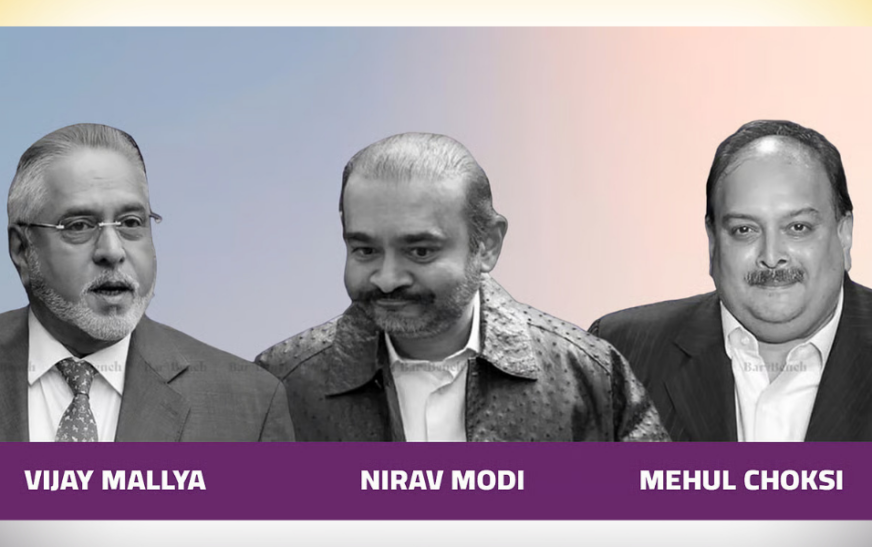
Crackdown on Fugitive Economic Offenders: Economic crimes account for 35% of all historical extradition cases handled by India. High-profile financial scammers who defrauded state-backed banks—including diamond merchant Nirav Modi and airline magnate Vijay Mallya—became prime targets.
Through the rigorous application of the Fugitive Economic Offenders Act and the Prevention of Money Laundering Act (PMLA): ₹17,874 crore worth of overseas and domestic assets belonging to these fugitives have been legally attached. ₹18,762 crore has been successfully recovered and returned to affected public sector banks and creditors through asset restitution.
The extradition status of India’s most high-profile financial fugitives remains tightly bound in legal manoeuvres, though major breakthroughs have recently shifted the landscape. The Enforcement Directorate (ED) has formally designated 21 individuals as Fugitive Economic Offenders (FEOs) under strict economic laws.
1.Nirav Modi (PNB Fraud Case) Current Status: Imminent Extradition (Administrative Phase)
Location: Wandsworth Prison, London, UK.
Legal Standing: He has exhausted all legal options. After being denied permission to appeal by the UK High Court, he approached the European Court of Human Rights (ECHR). The ECHR officially dismissed his final petition.
Next Steps: British authorities have initiated the handover process. The Ministry of External Affairs (MEA) is completing citizenship verification and final administrative formalities to fly him back to India.
- Vijay Mallya (Kingfisher Airlines Debt Case)
Current Status: Extradition Approved but Statutorily Delayed
Location: London, UK.
Legal Standing: Both the Westminster Magistrates’ Court and the UK High Court ordered and confirmed his extradition.
The Bottleneck: Mallya is using an undisclosed, confidential “secret legal matter” in the UK—believed to be an application for political asylum—to block his physical removal. The MEA has reiterated that while the core judicial process is won, they must wait for this confidential UK statutory loop to conclude.
- Mehul Choksi (PNB Fraud Case)
Current Status: Blocked by Citizenship Disputes
Location: Antigua and Barbuda.
Legal Standing: Choksi legally acquired Antiguan citizenship right before fleeing India. He has spent years weaponizing local Caribbean constitutional courts to tie up India’s extradition requests in lengthy litigation.
The Bottleneck: India is pursuing a dual strategy—fighting the extradition freeze in court while simultaneously pressuring Antigua to revoke his citizenship on fraud grounds so he can be deported directly.
- Sanjay Bhandari (Defense Arms Dealer Case)
Current Status: Extradition Ordered / Under Appeal
Location: UK.
Legal Standing: Wanted by the CBI and ED for hiding massive illicit income via overseas shell accounts. The UK courts approved his extradition, but his legal Défense team is actively appealing the execution.
The Ultimate Défense Weapon: “Indian Prison Conditions”.
The single largest hurdle blocking the physical arrival of these financial fugitives is a unified Défense strategy regarding human rights. Lawyers for Mallya, Modi, and Choksi successfully argued in foreign courts that Indian cells suffer from severe overcrowding, a lack of medical infrastructure, and violence.
To break this gridlock, Union Home Minister Amit Shah directed Indian states to construct specialized, international-standard high-security prisons explicitly for extradited fugitives. These facilities offer guaranteed 24-hour running water, natural sunlight, and square footage that matches European human rights criteria, actively dismantling the fugitives’ final legal Défense.
Current Development Status:
Tihar Jail (New Delhi): Authorities designated and prepared segregated high-standard enclosures inside Jails No. 4 and 7 exclusively for foreign-returned and extradited inmates.
Arthur Road Prison (Mumbai): Barrack No. 12 has been specifically upgraded as a high-security, well-ventilated wing with sovereign assurances and photographic evidence presented directly to foreign courts (such as in Belgium).
State-Level Directives: Union Home Minister Amit Shah urged all states and Union Territories to establish dedicated, world-standard prison cells in their capital regions to house high-profile deportees and economic offenders
Fugitive Economic Offenders Act (FEOA) and how it allows asset seizure before conviction:
The Fugitive Economic Offenders Act (FEOA) is a powerful Indian law enacted in 2018 designed to deter economic offenders from evading the law by fleeing the country. It targets high-profile fraudsters who choose to stay outside the jurisdiction of Indian courts to avoid criminal prosecution.
Key Criteria to Declare a Fugitive: An individual can be declared a Fugitive Economic Offender only if they meet specific legal thresholds:
The Threshold: The total value of the economic offence must be at least ₹100 crore.
The Action: An arrest warrant must have been issued against them by a domestic court.
The Evasion: The person must have left India to avoid criminal prosecution or refuse to return to face the law.
The Immediate Asset Seizure Mechanism: The most lethal feature of the FEOA is its provision for immediate asset seizure before conviction. Under traditional laws, properties can generally only be confiscated after a lengthy trial and final conviction.
Pre-Conviction Confiscation: Once an individual is declared an FEO, the Special Court can immediately order the confiscation of all their properties and assets.
Global and Domestic Reach: Confiscation applies to proceeds of crime, benami properties, and any other assets located either within India or abroad.
Vesting with the Government: All confiscated assets vest entirely with the Central Government, free from all encumbrances. No Civil Claims Allowed:
The offender loses the right to defend any civil claims regarding the seized properties in Indian courts.
How Seized Assets are Used:
Once the government takes control of the assets, the FEOA allows for a structured restitution process to fix the damage caused to the state and public sector banks: Asset Liquidation: Special administrators are appointed to manage, auction, or sell off the seized shares, real estate, and luxury items. Bank Restitution: The funds generated from these auctions are directly channeled back to the affected creditor banks and public institutions to recover unpaid debts.
Massive Recovery: To date, this aggressive mechanism has successfully recovered and returned over ₹18,762 crore to state-backed banks and creditors.
Source of Information:
- Statements of MEA. And MHA in Parliament.
- Others collected from public Domain.