
SINDHH NOT PARTITIONED
SARASIJ MAJUMDER
While in the year 1947, Partition of India carved East Punjab and West Bengal from respective undivided Provinces, and integrated to India, Sindh was handed over to Pakistan entirely intact. Despite dominating in the province’s major cities, Sindhi Hindus lost homeland, Property, and Business without any compensation as they faced a map impossible to divide and integrate with India.
All because—they didn’t have a strong Hindu Leader in congress to fight for them. Bengal had Dr. Shyama Prasad Mukherjee. Punjab had Master Tara Singh. Much later, Sindhis had Late Mr. L. K. Adwani—a powerful political leader of BJP.
The core reason was problem of demographics. The British formula only divided provinces that contained geographically contiguous districts where Muslims and Hindus each formed a majority. Other minorities were considered to be staying in INDIA, or Pakistan, as per their choice. Sindh had an overall Muslim majority of roughly 73%, with Hindus making up 26% of the balance population. Unlike in Punjab and Bengal, where minority Muslim populations were concentrated in massive, separable blocs either in the east or west of the respective state, the Sindhi Hindu population was not geographically concentrated enough to form an even single district-level majority.
Sindhi Hindus were overwhelmingly an educated, urban mercantile class. They dominated the commerce, education, and civil administration of all the major cities like Karachi, Hyderabad, Sukkur, and Shikarpur, but they were surrounded by vast rural hinterlands that were almost entirely populated by Muslims. Because there was no contiguous block of Hindu-majority districts, the British Boundary Commission was never even tasked with drawing a line through Sindh.
Geography also made creating a Hindu enclave impossible. Even if the British had wanted to carve out a territory for the Hindus of Sindh, there was no way to integrate it to India. Sindh was bordered by the Arabian Sea to the south, Balochistan to the west, and Muslim-majority West Punjab to the north. Its only border with India was the desolate Thar Desert to the east, far, far away from the urban centers where Sindhi Hindus actually lived.
Without a demographically feasible way for partition, the decision fell to the Sindh Legislative Assembly. On June 26, 1947, the assembly held a special session to decide its fate. Reflecting the province’s overall demographics, the assembly voted 33 to 20 to join the new Constituent Assembly of Pakistan.
Because their homeland could not be partitioned, Sindhi Hindus found themselves entirely inside the borders of a newly formed Muslim State, which was extremely hostile to Hindu population.
Unlike Punjab, Sindh did not see an immediate, explosive mass exodus in August 1947. However, within months, a massive, near-total migration of Sindhi Hindus to India took place, permanently altering the demographic and cultural landscape of the region.
The Triggers for Migration was Arrival of Muhajirs: Millions of Muslim refugees (Muhajirs) arrived in Sindh from Bihar and the United Provinces (UP) of India. They required housing and resources, creating intense competition and sudden communal friction in urban centers.
The January 1948 & Karachi Riots: On January 6, 1948, targeted anti-Hindu violence broke out in Karachi. This shattered the community’s sense of security and triggered panic, convincing most Sindhi Hindus that staying was no longer viable, and safe.
Evacuee Property Laws: The newly formed Pakistani government passed laws seizing properties left behind by those who fled. This was often extended to those merely planning to leave, stripping many affluent Hindus of their businesses and homes.
The Nature of the Exodus–Mainly by Sea and Train: The migration was primarily maritime and railway-based. Families crowded onto ships from the Port of Karachi to Bombay (Now Mumbai) or took trains across the border to Rajasthan and Gujarat.
Loss of the Elite: Sindhi Hindus made up the vast majority of Sindh’s urban elite, controlling commerce, banking, education, and bureaucracy. Their sudden departure left a massive administrative and economic vacuum in the new state of Pakistan.
A Community Uprooted: Roughly over 1 million Sindhi Hindus migrated to India between 1947 and 1949, leaving only an insignificant percentage (mostly in rural lower Sindh) behind.
Resettlement in India’s Refugee Camps: Arriving families were housed in military barracks and makeshift refugee camps. The largest was the Kalyan Military Camp near Mumbai, later renamed Ulhasnagar, which became a major hub for Sindhi culture in India. Other key settlements emerged in Gandhi Dham (Gujarat), Ajmer (Rajasthan), and Delhi.
Loss of Territory: Unlike Punjabis or Bengalis, Sindhi Hindus did not receive a corresponding piece of land within independent India to call their own. They became a completely displaced, diaspora community scattered across different Indian states.
Economic Resilience: Despite losing their ancestral lands and wealth, the community leveraged their traditional trading, entrepreneurial, and business skills to rapidly rebuild their lives, eventually becoming one of India’s most economically successful communities.
Cultural Preservation of Sindhi Identity in India: Because Sindhi Hindus did not receive a dedicated state during Partition, they faced the unique challenge of preserving their language, culture, traditions, and identity as a scattered diaspora. Over the decades, they utilized constitutional pathways, community networks, and economic success to keep their heritage alive.
The Constitutional Battle for the Language: The 8th Schedule: In the first two decades after Partition, Sindhis fought aggressively for political recognition. On April 10, 1967, their efforts succeeded when the Indian Government passed the 21st Amendment, officially adding Sindhi to the Eighth Schedule of the Indian Constitution.
OTHER NEW CHALLENGES:
- Lack of State Patronage: Unlike Punjabi or Bengali, Sindhis, though migrated has no state government to fund its schools, print textbooks, or mandate its use in local governance.
- Script Dilemma: The community split over which script to use. Some advocated for the traditional Arabic-Sindhi script (used in Pakistan), while others promoted Devanagari (Hindi script) to make it easier for younger generations born in India to learn. This division further fragmented language education.
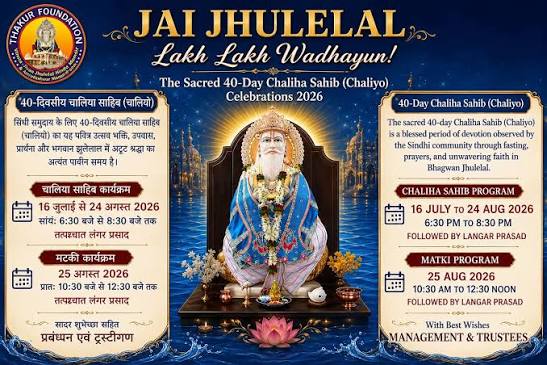
- Religious and Spiritual Anchors—’Saint Jhulelal’: To unite a scattered population, the community rallied around ‘Saint Jhulelal’, the patron saint of Sindhhis. Saint Jhulelal serves as a bridge between Hinduism and Islamic Sufism, reflecting Sindh’s syncretic past.
- Cheti Chand: The festival of Cheti Chand (Sindhi New Year) was deliberately transformed from a localized holiday into a massive, Global Day of Solidarity to bring dispersed Sindhis together annually.
- Sufi and Vedantic Trusts: Organizations built around saints like Dada Vaswani (Sadhu Vaswani Mission) and Sufi music traditions became cultural anchors, promoting humanitarian work alongside Sindhi values.
- Institutionalizing the Community–Educational Trusts: Rather than relying on the government, affluent Sindhi businessmen established private educational boards (such as the Hyderabad (Sindh) National Collegiate Board in Mumbai). They built dozens of schools and colleges across India.
- Quota System: Many of these institutions reserve a percentage of seats for Sindhi-speaking students, keeping youth tied to community networks.
- Enclaves and Townships: In places like Ulhasnagar (Maharashtra) and Gandhi Dham/Adipur (Kutch, Gujarat)—the latter built on land gifted by the Maharaja of Kutch specifically for Sindhi refugees—the language and culture flourished organically due to high population density.
- Modern Challenges and the Global Diaspora– Language Attrition: Today, fewer young Indian Sindhis speak the language fluently, as English and dominant state languages (like Hindi, Gujarati, or Marathi) have taken precedence for economic survival.
- Global Footprint: The preservation effort has shifted globally. Wealthy Sindhi diasporas in Hong Kong, Dubai, UK, and Spain fund international cultural festivals, satellite TV channels, and digital archives to document folk music and oral histories before they disappear.
I wrote this ‘BLOG’ as some of Indians are not fully aware of the sacrifices, and contribution of SINDHIS towards building India their new home. They suffered no less, and may be more than Bengali Hindus, or Punjabis from West Punjab.
I salute their spirit, and achievements.
SOURCE:
- NEWSPAPERS
- Information Scattered in various Public Domain.
Additional Read:
1.0 My BLOG on Ancient ‘SINDH’.