HOW BOMBAY-PUNE EXPRESSWAY WAS BUILT
SARASIJ MAJUMDER
The Mumbai-Pune Expressway (officially the Yashwantrao Chavan Expressway) was built by the Maharashtra State Road Development Corporation (MSRDC) between 1998 and 2002.
It was constructed as India’s first access-controlled six-lane concrete expressway to solve severe traffic congestion, bottleneck delays, and high accident rates on the old Bombay -Pune national highway.
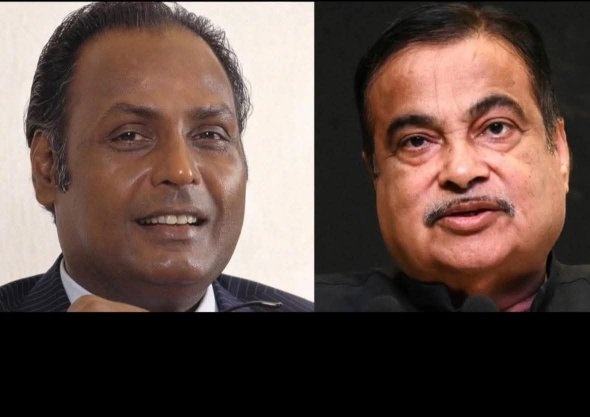
Nitin Gadkari, then a young politician, was appointed as Maharashtra’s Public Works Minister. During his tenure only, plans were drawn up for one of the country’s most ambitious infrastructure projects at that time — the Mumbai–Pune Expressway.
Traffic Crisis: By the late 1980s, the old Mumbai-Pune highway got highly congested, with travel times frequently stretching between 7 to 8 hours for a mere 160 km journey.
Feasibility Studies: In 1990, the Government of Maharashtra commissioned Rail India Technical and Economic Service (RITES) to conduct a feasibility study for a new, independent expressway.
It was approved, and a Global Tender was floated by state PWD.
Dhirubhai Ambani’s RELIANCE submitted a global tender proposal in 1995 to build the Mumbai-Pune Expressway. Reliance’s bid was lowest at ₹3,600/- crore to construct the expressway.
Dhirubhai Ambani was then one of Maharashtra’s most influential industrialists. His close relationship with Shiv Sena chief Bal Thackeray was well known.
But Nitin Gadkari threw a major obstacle on the way.
During a cabinet meeting, he argued that the road could be completed for less than ₹2,000/- crore. The problem was that the lowest tender on the table was ₹3,600/- crore.
Some of his colleagues argued that the contract should go to whoever had submitted the lowest bid. But Gadkari told Deputy Chief Minister Gopinath Munde that ₹3,600/- crore was far too much for a project that he believed could be completed for around ₹2,000/- crore.
He insisted that the tender should be rejected.
At the time, Dhirubhai Ambani had enormous influence in Government of Mumbai. Nevertheless, Gadkari managed to convince Chief Minister Manohar Joshi and Munde that the government could build the expressway at a much lower cost.
There was one major question: where would the money come from?
The government did not have enough funds.
Joshi asked Gadkari, “Where will the money come from?”
Gadkari reportedly replied, “Trust me… I’ll be able to make the arrangements.”
Chief Minister Manohar Joshi accepted his proposal and the tender was cancelled.
For Mr. Dhirubhai Ambani, this was a major setback.
Dhirubhai had excellent relations with Bal Thackeray and Pramod Mahajan. He was unhappy with the rejection of his tender and made his displeasure well known.
Pramod Mahajan then told Nitin Gadkari to meet Dhirubhai personally and explain the situation. Gadkari could not ignore Mahajan’s request.
Now—I will describe what I heard from an engineer friend of mine, then working in state PWD and also from others in Mumbai, about the meeting.
Gadkari went to meet Dhirubhai, and had dinner with Dhirubhai, Mukesh and Anil.
After dinner, Dhirubhai asked him: “So, how are you going to build the road? If the tender has been rejected, how will this project actually will happen?”
Gadkari replied, “If Reliance can submit a revised offer to build it for ₹2,000 crore, I’ll issue Reliance the LOI.”
Dhirubhai responded, “What is the government capable of? How are you going to build a road? It isn’t possible for you. You are being stubborn for no reason.”
He went on to tell Gadkari, “I have seen many ministers made claims like this before, but nothing ever got realized.”
In saying so, Dhirubhai had effectively challenged the young minister.
Gadkari took the words to heart.
It is learned that he replied, “Dhirubhai, if I fail to build this road, I will shave off my moustache. But if I manage to build it, what will you do?”
The meeting ended, and Gadkari walked away after challenging Dhirubhai.
Now there was one big question: How would the road actually be built — and where would the money come from?
Using his skills and political influence, Gadkari helped establish the Maharashtra State Road Development Corporation. Funds were raised through public and corporate participation.
With the support of Manohar Joshi and Gopinath Munde, the action started:
Institutional Setup: MSRDC was established in 1996 specifically to bypass bureaucratic delays and fast-track mega-infrastructure projects.
Funding and the BOT Mode–Public-Private Partnership: The expressway pioneered the Build-Operate-Transfer (BOT) funding model in India.
Financial Scale: The project was completed at a total cost of only ₹1,630 crore ($ 340MM, at that time) backed by government-guaranteed bonds. It was less than 50% of the Dhirubhai’s lowest bid!
Toll Recovery: Private consortia were given long-term concessions to operate, maintain, and recover the construction costs via toll plazas located at key strategic entries.
Engineering and Construction Phase (1998–2002) Divided Packages: To ensure rapid completion, the 94.5-kilometre route was divided into four separate construction packages awarded to different prominent Indian infrastructure companies.
Concrete vs. Asphalt: Engineers chose a reinforced concrete design rather than traditional asphalt. Concrete offered superior durability against the heavy monsoon downpours typical of the Western Ghats (Sahyadri mountain range).
Taming the Terrain: The project required cutting straight through rugged mountains. Work included building 5 major tunnels (spanning over 5,700 meters combined), dozens of underpasses, and multi-lane viaducts to keep gradients flat and eliminate tight, dangerous curves.
Phased Openings: Sections began opening as early as 1999, and the entire length from Kalamboli in Navi Mumbai to Kiwale in Pune was fully operational by April 2002.
Gadkari ultimately managed to complete the project for much less than ₹2,000 crore.
People were impressed by what he had accomplished.
News of the achievement eventually reached Dhirubhai Ambani as well.
He reportedly took a helicopter ride to see the expressway for himself.
After seeing the completed road, he was amazed.
He immediately invited Nitin Gadkari to meet him. The two met again at the Makers Chamber.
When they met, it is reported that Dhirubhai told him, “Nitin, I lost and you won. You actually built the road.”
“If there were four or five more people like you in this country, the destiny of India could change.”
Nitin Gadkari’s determination to take on even a powerful industrialist like Dhirubhai Ambani in order to save public money is a story that continues to be remembered in Maharashtra—but not very well known in other parts of India.
The Modern “Missing Link” Upgrade (2019–2026) The Khandala Bottleneck: For two decades, a 19 km stretch near the Khandala Ghat forced the new expressway to merge with the old, congested HIGHWAY, causing major traffic queues and landslide vulnerabilities.
The Solution: In 2019, MSRDC began constructing a ₹6,695 crore “Missing Link” project.
Engineering Record: This bypass features a spectacular 650-metre cable-stayed bridge over a deep valley and two twin tunnels. The underground tunnels measure 22.3 meters in diameter, holding the record for the widest underground tunnels in Asia.
Completion: Opened to traffic in May 2026, this final engineering feat shaved another 6 km and 25 minutes off the travel time, making the standard commute between the two cities just about two hours.
I drove through Old Bombay- Puna Highway—it was a nightmare. I started to drive through the segments as and when they opened.
In 2003, I drove through the whole stretch of newly built expressway to meet Shuvendu, [now no more, from B.E.College—one year junior to me] who was stationed and working in PUNE. It was an excellent drive except the bottleneck stretch.
Last June again I drove through it—it is really pleasant and smooth drive from Entry to Exit now.
FOOT NOTE: I used to be in Mumbai at least 50% of the year in those days, and many times went to Pune by Road. Building of this road was frequently talked upon then in Mumbai. I first learned about titbits of it from a Taxi driver in nineties, while I was commuting and decided to dig open the whole story, now shared.