

SWIM THOUGHT IMPOSSIBLE
FIRST MAN WHO CROSSED ENGLISH CHANNEL
SARASIJ MAJUMDER
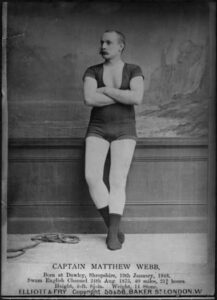
Captain Matthew Webb was a legendary Victorian merchant mariner, professional swimmer, and stuntman whose life was defined by extreme endurance and a tragic, fatal disregard for danger. His motto, “Nothing great is easy,” encapsulated his approach to open-water swimming.
He was the first man who crossed the English Channel by swimming on August 25, 1875.
Early Life & Navy Bravery Shropshire Roots:
Webb was born in the English Midlands at Dawley, Shropshire, in 1848, one of 12 children produced by Thomas and Sarah Webb. His father was a doctor.
He learned to swim in the highly dangerous, fast-moving currents of the River Severn.
Mariner Career: At the age of 12, Matthew enrolled as a sea cadet with the naval training ship HMS Conway in Liverpool. He became an experienced sailor and throughout his years at sea became a very good swimmer. He eventually became a captain of a steamship named the Emerald, with the Cunard shipping line.
Webb was celebrated across the British Empire for his fearless, almost suicidal impulse to rescue others at sea.
The Suez Canal Propeller Incident: While serving on a ship, the vessel’s propeller became dangerously tangled in a thick rope. Webb voluntarily dived directly beneath the ship into the dark water, spending an extended period of time cutting the ship free, narrowly avoiding getting crushed.
He demonstrated his heroism while serving as Second Mate aboard the Cunard steamer ‘Russia’ which was sailing from New York to Liverpool in 1873.
Medal for Valour: In 1873, in mid-Atlantic a sailor fell from the rigging mast into the ocean during a furious gale. The ship was cutting through the water at a high speed of 14.5 knots. Webb immediately dove straight into the mid-Atlantic trying to rescue him. He was in the water for 37 minutes, braving high waves, close to being lost. Webb failed to find the sailor. Webb survived the brutal waters and was hauled back aboard.
The First Stanhope Gold Medal: For his incredible courage during the Atlantic rescue attempt, the Royal Humane Society awarded Webb the very first Stanhope Gold Medal in 1874. This newly introduced award was designated strictly for the single most courageous civilian rescue of the entire year. He became a national hero.
Webb also received a £100 reward and became a household name before ever attempting the Channel.
He resigned from Cunard the following year having decided to seek fame as well as fortune as a professional endurance swimmer. Captain Webb’s exploits over the following eight years led one newspaper to describe him as “probably the best known and most popular man in the world”.
And he decided to cross English Channel by swimming!
His Grueling Training Regimen & Cold-Water Adaptation:
To survive the channel without a wetsuit, Webb trained in the freezing waters of the River Thames, Lambeth Baths, and Hollingworth Lake.
Bulking Up: To build an insulating fat layer against hypothermia, he ate massive amounts of food, regularly consuming two entire breakfasts and double dinner portions.
Test Swims: In July 1875, he swam a brutal 20 miles (32 km) from Blackwall to Gravesend on the River Thames in just five hours to prove his readiness.
THE HISTORIC SWIM:
The Route: He swam from Dover, England, to Calais, France.
The Time: The crossing took 21 hours and 45 minutes.
The Distance: While the direct line is about 21 miles (33.3 km), shifting tidal currents meant he actually swam nearly 39 miles (62.8 km).
The Method: He used breaststroke and sustained himself with sips of brandy, coffee, and beef tea.
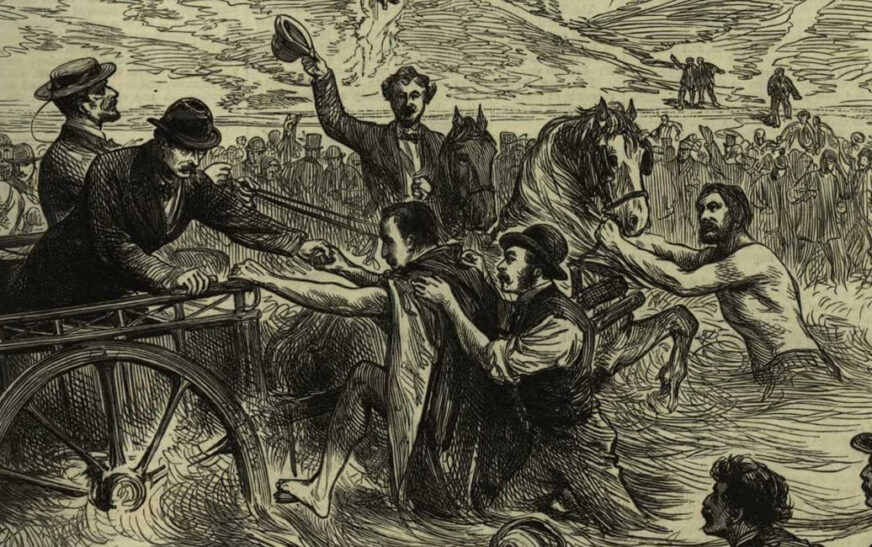
After covering himself with Porpoise oil to fend off the cold, he dived off Admiralty Pier, Dover, at 1pm on August 24, 1875, and swam towards Calais, trailed by a flotilla of three boats. An artist from the Illustrated London News was aboard in one of them.
Captain Webb was stung by jellyfish eight hours into his swim, but he carried on after receiving brandy from a supporter in one of the boats. It was said that at one stage he also paused for a cup of tea, served while he was treading water.
Finally, after 21 hours and 45 minutes of swimming, often against the tide, he waded onto the beach at Calais at 10.41am, the morning after he set out. Having swum the equivalent of 39 miles (62km), he was helped ashore and boarded a waiting carriage that took him to a hotel.
Life After the Channel :
Instantly he became a Victorian Celebrity. His achievement was celebrated all over the world. It brought him instant fame and he received a hero’s welcome wherever he went.
After his 1875 success, Webb became a global superstar. He generated income by writing a book, endorsing products (like matches), and performing endurance stunts, such as floating in a tank for 128 hours straight.
His popularity soared.
His book “The Art of Swimming” published in 1876. This book was the ‘BIBLE’ for budding swimmers for many years.
A hero’s welcome wherever he went was enjoyable and flattering but Webb needed money. And so, for the next few years, as well as treading the lecture circuit, he took part in various races and stunts.
He beat the United States champion, Paul Boyton, in a much-publicized race off Nantasket Beach in the town of Hull, Massachusetts.
But Webb had a wider repertoire and performed feats such as floating in London’s Westminster Aquarium for 60 hours. He repeated the performance at the Boston Horticultural Show a year later, where this time he floated in a tank for 128 hours!
Financial Struggles: As the public grew bored of basic endurance stunts, Webb began chasing more extreme and dangerous spectacles to support his family.
The Niagara Disaster:
Then, on July 24, 1883, Captain Webb attempted his final stunt: he was offered $2,000 if he could successfully swim through the Whirlpool Rapids of Niagara Falls. Friends tried to talk him out of it saying it will be suicide, but his reckless determination prevailed.
The Date & Time: He entered the water at 4:25 p.m. after being rowed out to midstream near the suspension bridge.
The Attire: He wore the same red silk swimming trunks he used during his historic English Channel crossing.
The Descent: He swam smoothly at first, covering a portion of the distance swiftly before a massive wave caught him.
The Tragedy: Witnesses saw him throw up his arms and cry out as the crushing force of the vortex pulled him under. He vanished approximately 10 minutes after diving in.
The Recovery: His bruised, mangled and bloated body was recovered four days later downstream, and an autopsy indicated he suffered respiratory failure and nerve center paralysis caused by the immense water pressure.
He was buried at nearby Oakwood Cemetery.
One visitor to the Falls later commented: “It truly is crazy to think a person could survive at the foot of that mad, loud, gargantuan crush of water. It’s like the weight of heaven itself descending all at once.”
In a special edition the Illustrated London News reported the death of “the bravest and greatest of all swimmers”.
LEGECY LEFT BEHIND:
The Captain Webb Medal Legacy: Webb’s bravery left such an impact that the Captain Webb Medal was later established in his honour by the Shropshire Society in London. It is still used to recognize modern individuals from his home county who display extreme, extraordinary courage in saving lives.
Captain Matthew Webb’s home county of Shropshire features several key heritage sites, structural memorials, and institutional tributes dedicated in preserving his legacy.
Coach Road in Coal Brookdale, Telford Administered by the Ironbridge Gorge Museum Trust: This heritage site hosts special exhibitions and collections archiving his childhood artifacts, family history documents, and local connections to the River Severn where he mastered swimming.
Civic & Educational Tributes in Shropshire Captain Webb Primary School: Located in Dawley, this local school proudly bears his name to inspire youth with his spirit of endurance.
Webb House: The prestigious Haberdashers’ Adams Grammar School in Newport, Shropshire, named one of its student houses after him.
Local Infrastructure: Dawley has integrated the explorer into its layout through streets named Captain Webb Drive and Webb Crescent.
Located in his birthplace of Dawley, Telford, historic Captain Webb Memorial fountain features a lion-head drinking tap and a profile portrait. Unveiled by his older brother Thomas in 1909, it is prominently inscribed with Webb’s life motto: “Nothing great is easy.”
The Coal Brookdale Church Porch Tablet: A unique memorial plaque resides inside Holy Trinity Church in Coal Brookdale, where Webb spent much of his childhood. Local church authorities placed the tablet inside the outer porch rather than the main sanctuary. This choice was made because Victorian society viewed his fatal Niagara swim as a reckless, suicidal act, which was considered a religious sin.
Last: His national monument located in Dover where he launched his channel swim.
I saw most of these memorials myself in the summer of the year 1994, and to salute him—I swam about a few hundred meters in English Channel, then, at Dover, also saluting, and remembering Mihir Sen—the first Indian, who also crossed English Channel, same route, in September 27, 1958—but he took 14 Hours and 45 minutes. However, he was better equipped.
References: All information are available in pieces scattered in various public domains. I compiled, and arranged chronologically.