
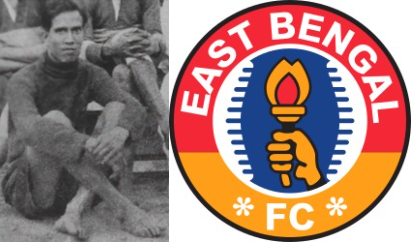
MONI TALUKDAR—A FORGOTTEN GOALKEEPER
SARASIJ MAJUMDER
Moni Talukdar (also recorded in early club rosters as M. Talukdar) was a pioneering Indian goalkeeper who played for East Bengal Club from its founding year in 1920 through 1935.
Moni Talukdar was born in 1903 in Lohajang, located in the Bikrampur sub-division of the Dhaka district of East Bengal ( present-day Bangladesh). He was the fourth child of his parents and received his primary education in Jhalokathi, Barishal. In mid-1920, he joined the East Bengal Club, introduced by Nagen Kali—the club’s first-ever goalkeeper. Initially, he served primarily as a backup goalkeeper to Nagen Kali, but from 1921, he secured the position of the club’s regular goalkeeper. He remained with the East Bengal Club for a total of 18 years, until 1938. During this tenure, he also served as the team’s captain for two consecutive years, in 1932 and 1933.
In the club’s century-long history, no one else has played for the East Bengal Club for such an unbroken, continuous period as Moni Talukdar—a true record. Although he missed several matches due to illness, he never left the club to join any other.
Moni Talukdar arrived in Kolkata in 1919 with the intention of studying art; he had hoped to enroll at Santiniketan. However, he could not afford the costs associated with tuition and living expenses there, so he enrolled at the Government Art School instead, taking up residence in the Kumartuli area. Having possessed a keen passion for sports since childhood, he frequently spent time at the Maidan. He began playing football at Kumartuli Park, where the sport was regularly played at the time. It was at the Maidan that he first met Nagen Kali, who was then playing for Mohun Bagan. When the East Bengal Club was established in 1920, Nagen Kali joined the new club and brought Moni Talukdar along with him. Throughout his time as a player, he never abandoned his interest in art; he graduated from the Government Art School and gained recognition as an artist. Ultimately, however, he focused more heavily on his sporting career, which limited his pursuits in the field of art.
1920 Founding Squad Roster
The official East Bengal FC player records group the original 1920 squad by playing position:
- Goalkeepers. Nagen Kali and Moni Talukdar.
- Defenders. Bhola Sen (B. Sen), Noni Gossain (N. Gossain), and Gostha Pal (on loan from Mohun Bagan).
- Midfielders. Prasanta Bardhan (P. Bardhan), Shashi Das (S. Das), Suren Tagore (S. Tagore), and J. Mukherjee.
- Forwards. Ramesh Chandra “Nasha” Sen (Captain), Sailesh Bose (S. Bose), Charu Bose (C. Bose), A. Roy, and A. Banerjee.
Career Highlights at East Bengal
- Playing Position & Tenure. He served as one of the club’s foundational goalkeepers during its earliest era in Kolkata. Across an 18-year association with the club, he anchored the defense as the Red and Golds rose from the second division of the Calcutta Football League to top-flight prominence.
- Club Captaincy. He was appointed official East Bengal Club Captain for two consecutive seasons in 1932–33 and 1933–34, becoming one of the earliest goalkeepers to lead the side.
- Historical Legacy. Remembered among East Bengal’s earliest stalwarts alongside contemporaries like Ramesh Chandra “Nosa” Sen and Mona Moulik, his career was commemorated in a special tribute feature by the East Bengal Club Archives featuring recollections from his family.
During Moni Talukdar’s playing era at East Bengal Club (1920–1937), the club was still in its formative years and had not yet won major top-flight honours like the IFA Shield or the Calcutta Football League First Division. Instead, their silverware came from foundational local tournaments and lower-division promotion campaigns.
Trophies Won (1920–1937)
- Hercules Cup (1920). Won just days after the club’s formation in August 1920, this seven-a-side tournament was the first trophy in East Bengal’s history.
- Khogendra Shield (1921). This tournament marked the club’s first-ever full 11-a-side trophy.
- Cooch Behar Cup (1924 & 1925). East Bengal won consecutive titles in this prestigious local knockout competition during the mid-1920s.
- CFL Second Division Runners-Up & Promotion (1924). While not a championship trophy, finishing second in the Calcutta Football League Second Division earned the club its historic promotion to the First Division for the 1925 season.
Context of the Era
- Building the Foundation. Throughout the late 1920s and 1930s—including Moni Talukdar’s two seasons as club captain in 1932 and 1933—East Bengal focused on establishing itself against dominant British military teams and established Indian clubs like Mohun Bagan and Mohomedan Sporting Club .
- Post-Retirement Breakthrough. The club’s major trophy cabinet began expanding shortly after Talukdar’s 18-year playing career ended, starting with their first Calcutta Football League First Division title in 1942 and their first IFA Shield in 1943.
Throughout his long sporting career, Moni Talukdar witnessed many of his club’s ups and downs. He was present from the very inception of the club, and he also witnessed the proud moment when, just five years later, the club qualified for the First Division Football League. Conversely, he had to endure the pain of the club’s crisis in 1928—a dark period during which he fought back with grit and determination. Success returned in 1931, and Moni Talukdar was there to witness that as well. He played in many memorable matches, several of which were against British clubs. For five years, he served as the goalkeeper for the Indian team in international matches against the British. He also captained East Bengal Club during its first-ever tour of Burma. He was employed at the B.G. Press, where he led the office team to six championship titles in the office league. Beyond football, he was also proficient in cricket, tennis, and hockey; he even played hockey for East Bengal until 1936.
He played consistently for many years, owing to his own merit and exceptional physical stamina. He was a vibrant individual with a deep love for his club. A revealing anecdote comes from Surya Chakraborty: after East Bengal Club regained its place in the First Division of the Calcutta League in 1931, Surya Chakraborty took the initiative to recruit talented players from various places to build a formidable squad. During this time, Moni Talukdar received an offer to play for Mohun Bagan. He flatly refused. When Surya Chakraborty later asked him about it, Moni Talukdar replied, “Can you imagine their audacity—asking me to play for their team! I am a man from Dhaka; if I were to join them, I wouldn’t even find a place in hell! How could I ever face my parents again? I sent them packing immediately!”
According to the writings of his contemporaries, Moni Talukdar once remarked that the year 1928 was the time he experienced the greatest pain. That year, the team was already weakened as five players left to join the Railways team. To make matters worse, just as the league season began, Moni Talukdar fell victim to a severe bout of cholera. After a month-long struggle between life and death, he managed to recover to some extent; however, he remained so physically frail that he lacked the strength to take the field. That year, Moni Talukdar was the only reliable goalkeeper for East Bengal Club, and his inability to play had a profound impact on the team.
In his absence, the club cycled through at least eight different goalkeepers, none of whom could provide any sense of stability or confidence. Between the loss of several key first-team players and the persistent goalkeeping crisis, East Bengal Club performed dismally in the league and was relegated to the second division. It is said that during the final matches of the league, Moni Talukdar would arrive at the ground despite his frail condition, insisting on playing when he saw the team’s dire situation. When others, concerned for his health, urged him not to, tears would stream down his eyes.
Such deep love and intense passion for a club are rarely seen today. In those days, playing for the club brought no financial reward or special perks; yet, the players gave everything they had for the sake of the club. Simply being able to play for East Bengal Club was a matter of great pride and honor.
It is worth noting that East Bengal Club made an extraordinary effort to emerge from the darkness of this crisis and reclaim success—an effort that ultimately bore fruit. Let me elaborate: in the mid-1920s, a group of exceptional players joined East Bengal Club, forming a bond as close as a family. Their constant mentor and guardian was the club’s secretary, the respected Banwarilal Roy. Even when some players departed towards the end of the 1920s, that “family” remained intact. Banwaribabu knew that success would eventually come through these very individuals. Following a disastrous performance in the 1928 Calcutta League, a decision was once reached to shut down the club’s football division. However, the club administrators placed their faith in the words of the players. It was upon this foundation—a family-like bond between players and administrators—that East Bengal Club was able to make a comeback. Mona Moulik served as captain in 1929, 1930, and 1931; even after he retired from playing, the club administrators appointed him as the football secretary from 1932 to 1934—recognizing that achieving success required that same sense of an extended family and that same spirit of teamwork. Furthermore, unable to accept the club’s decline, several players who had previously left returned, one by one. Together, they joined forces to bring in new talent and restore the club to its rightful standing. This is the unique hallmark of East Bengal Club—a quality that sets it apart from any other. Within this club, there was no divide, nor any distance, between the players and the administrators during those days.
1938 was another painful year in the life of Moni Talukdar. Towards the end of that year, he was diagnosed with cancer—a condition that had already reached an advanced stage. In his final days, lying in a hospital bed, he held Surya Chakraborty’s hand and asked, “Tell me, Surya, why did God do this? Couldn’t He have let me live for just a few more years? I could have played for the team for a while longer.”
One can only imagine the depth of love a player must have for his club to utter such words. Devoting so much time to the sport, he never even considered marriage; he used to tell his family, “The playing field is my home and family.” But fate did not grant him any more time on the field. On May 17, 1939, at the age of only 36, Moni Talukdar left us all. His parents were still alive at the time of his passing.
Even today, Moni Talukdar remains etched throughout the history of East Bengal Club; he lives on within the hearts of thousands and in the cherished memories of countless supporters—truly serving as the eternal, living flame of East Bengal.
How Moni Talukdar Compares
- Longevity vs. Silverware. Talukdar spent nearly two decades building the club’s survival and identity in British-era Kolkata, whereas successors like Thangaraj and Bose arrived when East Bengal was already a powerhouse competing for national crowns.
- Rare Goalkeeper Captains. Leading East Bengal as captain is rare for a goalkeeper, putting Talukdar in an exclusive club alongside Indian football icon Peter Thangaraj.
- Historical Impact. While modern keepers like Gurpreet Singh Sandhu and Prabhsukhan Singh Gill are measured by clean-sheet percentages and national league appearances, Talukdar’s legacy rests on establishing the club’s competitive spirit from day one.
LONG LIVE MONI TALUKDAR IN THE HEART OF FOOTBALL LOVERS OF WEST BENGAL.
ANECDOTE: I gathered as much information as possible on him from various scattered sources, and put that in one place for the sake of posterity. Readers are requested to share any information I missed in comment section for me to update.