OPERATION BARGA
SARASIJ MAJUMDER
KEY DEFINITIONS:
Bargadars: Defined under the West Bengal Land Reforms Act, 1955 as someone who cultivates another’s land under systems locally known as adhi, barga, bhag, or kisani. Elsewhere—they are known as ‘Sharecroppers’.
Exclusions: Close family members of the landowner (such as a spouse, child, parent, or sibling) are not classified as Bargadars.
Legal Rights: Recorded Bargadars hold protected, heritable cultivation rights to the specific plot of land, preventing arbitrary eviction by landowners.
Operation Barga: A historic 1978 land reform movement in West Bengal that legally registered millions of these sharecroppers to secure their tenancy rights against landlords (JOTEDARS) by the then CPI (M) Government.
In sociological and economic studies of West Bengal, peasants are commonly classified into five main strata based on land ownership, control over assets, and labor participation:
Rich Peasants, Middle Peasants, Poor Peasants, Sharecroppers (Barga/Adhiar), and Agricultural Laborers.
Rich Peasants (Jotedars / Malik): Own or control large portions of land relative to the regional average (historically above 5–10 acres). Frequently hire outside wage labor rather than relying solely on family labor. Often act as rural moneylenders or traders, deriving substantial income from exploiting the labor of lower tiers. [ Malik means ‘Owner’]
Middle Peasants: Hold moderate-sized landholdings that generally sustain family consumption needs. Cultivate land primarily using family labor, seldom hiring or selling labor. Economically vulnerable to price shifts and crop failures but maintain independent self-sufficiency under normal conditions.
Poor Peasants: Possess very small, marginal plots of land insufficient for family survival. Supplement their meager farm income by working as wage laborers on other farms.
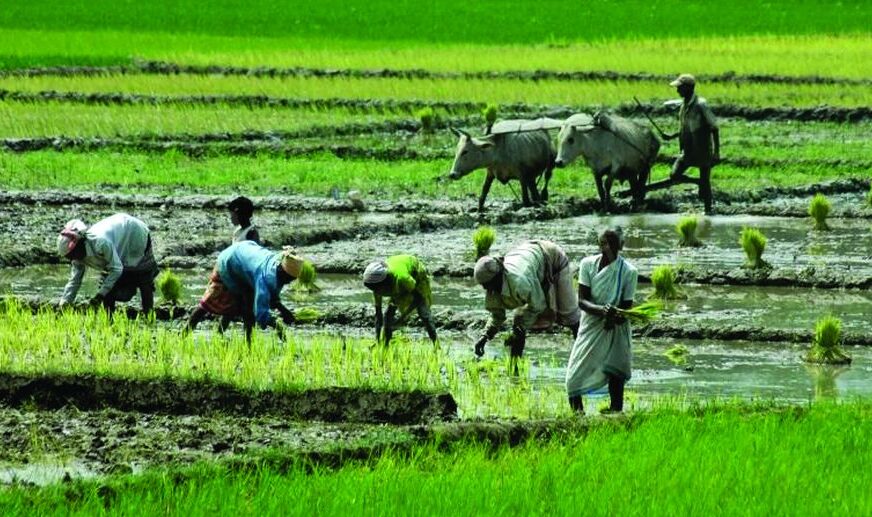
Sharecroppers (Bhag Chashi or Adhiar): Do not own land or have secure formal titles, leasing plots from landlords or rich peasants. Cultivate the land and share a fixed proportion (traditionally half) of the crop produce with the owner. Protected historically through tenancy reforms like Operation Barga in West Bengal. [Chashi means ‘Peasant’.] They are Bargadars.
Agricultural Laborers (Krishi Shramik / Mazdoor): Form the bottom tier of the agrarian hierarchy with little to no land ownership. Depend entirely on manual wage labor working on fields owned by others.
Operation Barga was a historic land reform movement launched in 1978 by the Left Front government in rural West Bengal. Its primary goal was to officially record the names of sharecroppers (Bargadars) to grant them permanent hereditary occupancy rights and prevent unlawful eviction by wealthy landlords.
Before this initiative, registering land rights through traditional bureaucratic settlement machinery was extremely slow and heavily skewed in favor of powerful landowners. Operation Barga bypassed this by holding evening village assemblies (Krishi Shibirs), allowing sharecroppers to register their claims collectively in front of their peers, which neutralized intimidation from landlords.
Key Aspects of Operation Barga: Legal Protection Against Eviction: Once a sharecropper was officially registered, landlords could no longer evict them arbitrarily. The right to cultivate the land became secure and hereditary.
Fair Crop Sharing: It strictly enforced a regulated share of the harvest. If the Landlord provided inputs (seeds, fertilizer, bullocks), the crop was divided 50:50. If the Bargadar provided the inputs, they were entitled to 75% of the produce, with only 25% going to the landlord. Often, they had some kind of written agreement with Bargadar, mostly one sided—and legally not tenable. But, this paper forms the basis of ‘Establishing who is Bhag Chashi’, for moving forward.
Massive Scale: The program concluded by the mid-1980s, successfully recording the names of approximately 1.5 million Bargadars.
Economic Empowerment: Securing these rights allowed sharecroppers to access formal institutional credit (like Bank Loans) using their Registered Cultivation Rights as collateral, reducing their reliance on exploitative rural Moneylenders.
Political Power got Re-Balanced:
Dominance of wealthy rich peasants (Jotedars) ended. Empowered poor and middle peasant. Mobilization of those votes, including their family, went to CPI(M). That is why—Hooghly, part of Midnapur and East Burdwan district got converted to CPI(M) stronghold.
But, this reform didn’t help the poorest class—the Agricultural Labourers.
IMMEDIATE GAIN:
Long-Term Impact on Agricultural Productivity: Operation Barga triggered a massive turnaround in West Bengal’s agricultural economy throughout the 1980s, shifting it from a stagnant sector to one of India’s fastest-growing agrarian states.
The Incentive Effect: Historically, insecure tenants had no motivation to improve the soil because landlords could evict them at any moment. Permanent tenancy and a guaranteed 75% crop share shifted the economic incentive squarely to the Bargadars. They invested heavily in their plots using better seeds, fertilizers, and private tube-well irrigation.
Measurable Growth: Research by economists Abhijit Banerjee and Maitreesh Ghatak estimated that Operation Barga alone accounted for approximately 36% of the total growth in West Bengal’s agricultural production between 1977 and 1990.
The “Boro” Rice Boom: This legal security combined perfectly with the simultaneous rollout of Boro (dry-season) irrigated rice and state-decentralized Panchayat aid. Food grain yields boomed, averaging an impressive 3.6% annual growth from 1980 to 1999.
The Stagnation Plateau: By the early 2000s, this growth trajectory hit a wall. Once the initial productivity gains from tenant security and Boro rice maximization were exhausted, the small size of the plots prevented further industrialization or scaling, causing West Bengal’s agricultural productivity growth to plateau compared to states with larger farms.
Major Criticisms of the Program: While highly lauded as a successful social justice mechanism, Operation Barga faced deep systemic criticisms over time: Severe Land Fragmentation: Because land was divided among millions of individual sharecroppers, the average plot size plummeted. Over the generations, further inheritance split these plots into even smaller, non-viable fractions. This prevented modern mechanization (like using tractors efficiently) and kept farming largely restricted to subsistence levels.
Neglect of Agricultural Laborers: The program focused strictly on sharecroppers, leaving out the landless agricultural laborers (Krishi Shramik). Critics argue it created a new rural elite out of the registered Bargadars, while doing very little to raise the minimum wages or protect the livelihoods of the absolute poorest labor tier.
Deterioration of Rural Credit Balance: Before the reform, landlords (JOTEDARS) often advanced informal production and consumption loans to their Sharecroppers. Following the bitter legal shifts of Operation Barga, landlords abruptly halted these loans. While the state attempted to fill the gap with formal bank credit, institutional credit was frequently slow or inadequate, pushing some peasants back into the hands of traditional Moneylenders.
The Modern “Ghost Entries” Bottleneck: Because Barga rights were tied to the land plot permanently and made hereditary, they could not be easily altered or transferred. Decades later, updating land records has become a severe administrative mess. There are hundreds of thousands of “ghost entries” where descendants of Bargadars no longer farm the land, yet the outdated Barga listings prevent landowners from selling or repurposing the contiguous land parcels for housing, industry, or commerce. Or even ‘Mechanized Farming’.
Economic Impact on the Jotedars Class: The Jotedars (wealthy, traditional landowning class) faced a catastrophic blow to their absolute rural dominance. Erosion of Land Value and Control: Because a registered Barga entry became a permanent encumbrance on the property asset, the market value of Jotedars lands plummeted. A landlord technically owned the property but could neither sell it at a premium, use it as flexible collateral, nor evict the tenant to farm it themselves.
Loss of Economic Extraction: The Jotedars were forced to legally surrender up to 75% of the crop yield to the tenant if the tenant provided the farming inputs. Their ability to extract surplus value, demand free labor or charge usurious interest rates on informal emergency loans was drastically curtailed by the empowerment of local Panchayats.
The Rise of “Parallel Disempowerment”: While massive Jotedars survived by diversifying into urban businesses, trading, and politics, smaller or marginal landlords who relied entirely on rental income from sharecropping suffered deeply. Studies note that many smaller landowners were effectively pushed into poverty over the long term, unable to access or utilize their own asset.
WAY OUT:
To improve West Bengal’s agrarian system and address the EXISTING BOTTLENECKS LEFT BEHIND BY OPERATION BARGA, economists, policy experts, and agricultural scientists generally recommend a transition from historical land redistribution to structural modernization and value-chain integration.
- Resolve the “Barga” Record Bottlenecks: Voluntary Barga De-Registration: Introduce a state-backed framework for mutually agreed-upon financial settlements between landowners and descendants of Bargadars. If a family no longer wants to cultivate the land, they should be allowed to legally surrender or sell their Barga rights back to the landowner for fair compensation.
- Digital Land Audit: Conduct a comprehensive GIS-mapped digital land survey to clean up “ghost entries” (records of deceased or non-practicing Sharecroppers). This will clean up land titles and revive a transparent land-lease market.
- Overcome Land Fragmentation: Promote Farmer Producer Organizations (FPOs): Encourage small and marginal farmers to aggregate into FPOs. By pooling their small plots together for cultivation, they can achieve economies of scale, purchase modern machinery (like harvesters and drones) collectively, and gain bulk bargaining power when buying seeds and fertilizers.
- Legalize Corporate/Group Leasing: Update land leasing laws to allow formal, secure, short-term land pooling by farmer groups or agribusinesses without the fear of the owner losing their permanent land title.
- Diversify Beyond “Boro” Rice Crop cultivation: West Bengal’s heavy reliance on water-intensive Boro rice has severely depleted groundwater tables. The government should offer incentives, technical training, and minimum support price (MSP) assurances for shifting to high-value, climate-resilient crops like pulses, oilseeds, maize, and organic vegetables. Rice shall be cultivated only during ‘MONSOON’. You can have two Crops per monsoon.
- Horticulture and Floriculture Expansion: Given West Bengal’s diverse Agro-Climatic zones, shifting small plots toward fruits, flowers, and medicinal plants can generate significantly higher income per acre than traditional cereal farming.
- Build Infrastructure and Modern Supply Chains–Cold Chain and Warehousing: Up to 30% of perishable horticultural produce in the state is wasted due to poor storage. Investing in a network of solar-powered cold storages at the block level will allow poor peasants to store crops and sell them when market prices are favorable.
- Direct Market Access (Bypassing Middlemen): Strengthen digital marketing infrastructure like e-NAM (Electronic National Agriculture Market) and create localized, farmer-run direct markets (Krishi Mandis) to reduce the influence of exploitative rural middlemen (Aratdars).
- Support the Lowest Tier (Agricultural Laborers) Skill Development and Rural Non-Farm Jobs: Since land plots are too small to sustain growing generations, the state must generate non-farm employment. Setting up rural food-processing units, textile clusters, and agro-industries will absorb surplus agricultural laborers into higher-paying jobs.
- Strengthen Social Security: Ensure strict implementation of fair minimum wages, insurance schemes, and year-round employment guarantees (like MGNREGA) to support landless workers during lean farming seasons.
I request present CM of West Bengal to address this problem, created by Late Mr. Hare Krishna Kongar, a class eight pass self-styled agrarian economist- cum politician of CPI(M).
References:
1.0 Listed in the Text.
2.0 Available in Public Domains.
![NAVA-RATRA [ NINE NIGHTS]](https://sarasijmajumder.in/wp-content/uploads/2026/10/RAVAN-PORA-1.jpg)