
*MYMENSINGHA BALLADS*
PART–I
SARASIJ MAJUMDER
*MYMENSINGH BALLADS*, or *MAIMANSINGHA GITIKA* is an ancient and rich literature of Bengali language. It is a compilation of ‘folk stories.
Maimansingha Gitika (also spelled Mymensingha Gitika or Maimansingha Geetika) is a world-renowned compilation of traditional Bengali Folk Ballads originating from the greater Mymensingha and Netrokona regions of present-day BANGLADESH.
These ‘ballads’ has immense social, political historical and literary values on History of undivided Bengal.
Most of the folk ballads compiled in the Mymensingh Geetika (or Maimansingha Gitika) were composed between the 16th and early 18th century.
Because it is an anthology of oral folk folklore originally sung by rural poets and Bayatis, the individual stories were composed and passed down across generations before being officially collected by Chandra Kumar De and published as a compilation by Dr. Dinesh Chandra Sen, and published in 1923 by the university of Calcutta. It was edited by the eminent scholar Dinesh Chandra Sen. The fieldwork and actual collection of these oral songs from rural bards were primarily executed by Chandra Kumar Dey. A parallel English translation was published as Eastern Bengal Ballads.
The 10 core ballads (palas):
The first volume of the collection features ten major narrative Ballads:
- Mahua (মহুয়া): Composed by Dwija Kanai. A romantic tragedy revolving around mahua, a girl stolen by a gypsy leader who falls in love with a prince, Nader Chand.
- Malua (মলুয়া): assumed to be composed by the famous 16th-century poet Chandrabati. It follows the love between Malua and Binod, demonstrating the resilience of a rural woman confronting oppressive patriarchal norms.
- Chandravati (চন্দ্রাবতী): the tragic tale of the real-life female poet Chandrabati and her unfulfilled love for Jayananda.
- Kamala (কমলা): a story highlighting female chastity, struggles, and ultimate triumph over societal exploitation.
- Dewan Bhabna (দেওয়ান ভাবনা): explores themes of power, zamindari influence, and romantic conflict.
- Dasyu Kenaramer pala (দস্যু কেনারামের পালা): composed by Chandrabati, it narrates the reformation of a notorious bandit named Kenaram through a series of spiritual folk songs.
- Rupabati (রূপবতী):the story centers on a young woman who fights for her choice of marriage against feudal constraints.
- Kangka o Leela (কঙ্ক ও লীলা): a poignant romantic saga cutting across class and caste lines.
- Kajolrekha (কাজলরেখা): a fairytale-like narrative involving a dedicated princess, trials of fate, and magical realism. It is stated hereunder.
- Dewana Madina (দিওয়ানা মদিনা):Composed by Mansur Bayati, this depicts the painful separation and deep devotion of a rural Muslim woman, Madina, towards her husband.
I will share with my readers some of those beautiful ‘ballads’. Today it is – “Kajolrekha”.
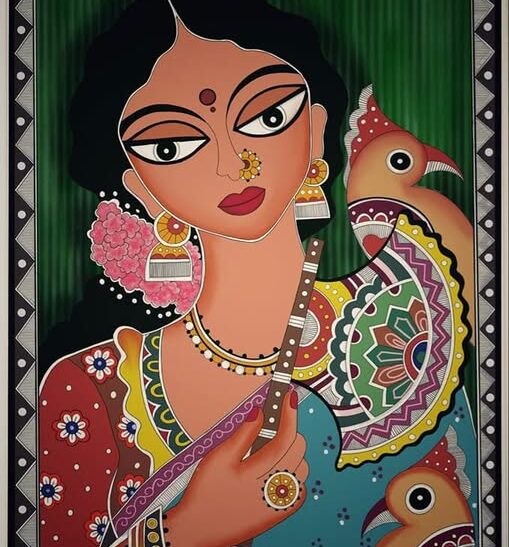
‘Kajolrekha’ is one of the ten ancient ballads included in the *Mymensingha ballads* (*Maimansingha Gitika*), though the identity of its author remains unknown. In truth, ‘Kajolrekha’ is not a ballad in the conventional sense; it is the only fairy tale within the *Mymensingha ballads*, narrated through a blend of poetry and prose. Notably, it had already appeared in *Thakurmar Jhuli*—a collection of folk tales compiled by Dakshina Ranjan Mitra Majumdar—even before its inclusion in the *Mymensingha Ballads*.
Both versions read together, reveals small differences.
Story:
Dhaneshwar was an immensely wealthy merchant from the Bhati-al region. He had a son, Ratneshwar, and a daughter, Kajolrekha, who was exceptionally beautiful. Life was blissful for the family. The merchant would travel from city to city for his trade, but fate took a cruel turn: after losing a wager, Dhaneshwar was reduced to abject poverty. He wandered from place to place, unable to find any way out of his misfortune. At this juncture, an ascetic appeared. Moved by Dhaneshwar’s plight and his story, the ascetic gifted him a ring and a virtuous parrot, instructing the merchant to follow the bird’s directions to the letter.
Following the parrot’s counsel, Dhaneshwar sold the ring at the marketplace and used the proceeds to resume his trade. Before long, he regained his former wealth, and the family’s happy days returned. One day, the parrot suddenly instructed that Kajolrekha be left in the forest, claiming she was destined to marry a dead man. Though heartbroken, the merchant felt compelled to obey the parrot. He took his young daughter, Kajolrekha, into the forest and left her sitting on the steps of a dilapidated temple while he went to fetch some water.
Driven by curiosity, Kajolrekha stepped inside the temple, whereupon the doors closed shut on their own. When Dhaneshwar returned with the water, he tried in vain to open the doors. Inside the temple lay the body of a deceased prince. Seeing him, Kajolrekha became terrified. She cried out and told her father everything. Upon hearing this, Dhaneshwar recalled the words of the parrot (*Shukpakhi*). He explained everything to his daughter, Kajol, revealing that the deceased prince was, in fact, her husband. Dhaneshwar then departed, wiping tears from his eyes.
Left alone, Kajolrekha began to weep in fear. Just then, an ascetic appeared. Seeing her crying, the ascetic said, “there are needles embedded in your husband’s body; you must remove them.” he handed her a vessel containing leaf extract and instructed, “use this extract to remove the needles from his eyes; doing so will restore the prince to life. However, you must not reveal your own identity to the prince yourself—the parrot will do that for you. If you fail to follow this, the prince will die.” the ascetic then left, unlocking the temple doors as he departed.
Yet, Kajolrekha did not flee. Instead, following the ascetic’s instructions, she spent seven days tending to her deceased husband. She removed all the needles from his body, one by one, leaving only the two embedded in his eyes. Deciding to first bathe and perform worship to the goddess, she went to the edge of a nearby pond.
By the pond, Kajolrekha encountered a merchant who was offering a poor girl for sale. Moved by compassion, kajolrekha used the bracelet (*Kankan*) from her own wrist to purchase the girl from the merchant, taking her on as a housemaid. She named her ‘Kankandasi’. She then explained the entire situation to her and instructed her to go to the temple and look after the prince.
Upon reaching the temple, Kankandasi applied the leaf extract provided by the ascetic to the prince’s eyes and removed the needles. The prince was restored to life. In gratitude, he accepted Kankandasi as his queen. After her bath, when kajolrekha returned to the temple, the *kankan-dasi* (her maid) told the prince that Kajolrekha was their maid. Remembering the ascetic’s words, Kajolrekha did not protest, nor did she reveal her true identity to the prince.
The prince returned to the palace with the queen, bringing along Kajolrekha, who was disguised as a maid. However, as time passed, the prince began to grow suspicious, noticing the inconsistencies in the queen’s behavior contrasted with the exceptional skill and competence shown by Kajolrekha. The Maid, sensing the prince’s growing suspicion, leveled false accusations against Kajolrekha, leading to her exile on a remote island.
Many years went by. One day, Ratneshwar—who had expanded his father Dhaneshwar’s trading business following his father’s death—happened to sail past that island. Upon discovering the beautiful Kajolrekha alone on the island, he took her aboard his ship. Having been separated since early childhood, neither recognized the other.
Meanwhile, the prince, having exiled Kajolrekha, began to suffer from deep remorse. Without revealing her identity, Ratneshwar announced that he was to marry an exquisitely beautiful maiden from across the sea. He declared that, before the wedding, his pet parrot would reveal the maiden’s identity to all. Everyone was invited to the event, including Kajolrekha’s actual husband. As the parrot recounted the entire life story of Kajolrekha, all misconceptions were dispelled. The brother was reunited with his long-lost sister. The prince, seeking forgiveness for his error, brought Kajolrekha back to the palace, restoring her to her rightful status as his wife, and Queen. The parrot departed for heaven, while the treacherous maid was buried alive.
Source: Maimansingha Gitika (Ballads Of Mymensingh)-By Dr. Dinesh Chandra Sen.
Image: google.
Note: Those who have not read this book— I request to read.