
INDIA’S STEALTH FIGHTER JET PROJECT
SARASIJ MAJUMDER
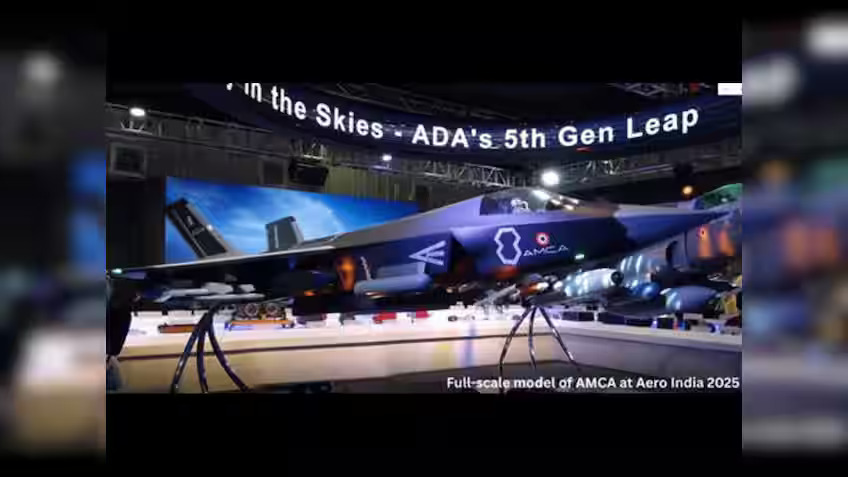
India embarked in building fifth-generation stealth fighter jets under the AMCA programme. It will be manufactured in Puttaparthi, Andhra Pradesh.
The Advanced Medium Combat Aircraft (AMCA) project is a bold and ambitious initiative by the Defense Research and Development Organization (DRDO). The state government has allotted 600 acres of land to the DRDO for this super high-tech aerospace facility.
The Advanced Medium Combat Aircraft (AMCA) will be designed and engineered to be a 5th-generation stealth fighter that transitions into 6th-generation capabilities with the Mark 2 variant.
PROJECT KEY DETAILS
Total Investment Estimated: approximately ₹1 lakh crores ($12 billions)
Production Target: Approximately 140 stealth jets.
Key Partners Shortlisted: Tata Advanced Systems, Larsen & Toubro (L&T), and Bharat Forge.
Strategic Advantage: Proximity to the Aeronautical Development Agency (ADA) in Bengaluru and access to an under-utilized airstrip with clear airspace.
Development Timeline:
Foundation Stone: Expected to be laid on May 15, 2026, by Chief Minister N. Chandrababu Naidu.
First Prototype: Targeted for rollout by September 2027. (??)
Maiden Flight: Planned for September 2028.
Full Production: Expected to begin by 2034–2035.
The facility will serve as a final assembly and ground testing hub, complementing the design and modular assembly work done at the ADA in Bengaluru.
SPECIFICATIONS
The AMCA is a twin-engine, single-seat fighter designed for air superiority and deep penetration strike missions.
Max Take-Off Weight:25 tonnes (Medium-weight class)
Maximum Speed: Mach 2.15 (~2,600 km/h)
Combat Range:1,620 km
Service Ceiling: 65,000 feet (approx. 20,000 meters)
Internal Fuel Capacity: 6.5 tonnes
Stealth and Weaponry: The aircraft features a modular design to balance low observability with heavy strike capability.
Stealth Mode: Uses an internal weapons bay with a 1,500 kg capacity to minimize radar cross-section.
Non-Stealth Mode: Can carry an additional 5,500 kg of munitions on 14 external hardpoints.
Armament: Planned to carry Astra Mark 3 BVRAAMs, BrahMos-NG cruise missiles, and potentially Directed Energy Weapons (DEW) in the future.
Engine Evolution: The project follows a phased engine strategy to ensure development timelines are met.
AMCA Mark 1: Powered by two General Electric F414-INS6 engines (98 kN. class).
AMCA Mark 2: Targeted to use a more powerful 110–130 kN. indigenous engine, developed in collaboration with partners like Safran or Rolls-Royce, enabling super cruise (supersonic flight without afterburners).
Next-Gen Avionics & AI Electronic Pilot: An AI-assisted system for real-time decision support and reducing pilot workload.
Sensor Fusion: Integrates inputs from AESA Radar, IRST, and missile warning systems into a single situational display.
MUM-T: Capable of Manned-Unmanned Teaming, allowing the pilot to command a swarm of autonomous “loyal wingman” drones.
The Advanced Medium Combat Aircraft (AMCA) achieves its low observability (stealth) through a combination of physical design and advanced materials. Its Radar Cross-Section (RCS) is expected to be as low as 0.0001 square meters in its cleanest configuration, making it nearly invisible to conventional radar.
Geometric Stealth (Shaping): The most critical stealth feature is the aircraft’s physical shape, designed to deflect radar waves away from the source rather than reflecting them back.
Serpentine (S-duct) Air Intakes: These curved ducts completely conceal the engine fan blades, which are highly radar-reflective.
Diverterless Supersonic Inlet (DSI): This design eliminates the need for moving parts at the air intake, reducing both radar reflections and maintenance needs.
Edge Alignment: Every major edge and surface—including wings, tails, and bay doors—is aligned at the same angle to ensure that radar energy is concentrated in narrow “spikes” away from enemy sensors.
Canted V-Tail: The twin vertical stabilizers are tilted outward to reduce their radar signature while maintaining high-speed control.
Internal Weapons Bay (IWB)To remain stealthy during combat, the AMCA carries its primary weapons inside the fuselage.
Capacity: Two large internal bays can hold up to 1,500 kg of munitions, typically four Astra Mark 3 air-to-air missiles or eight Smart Anti-Airfield Weapons (SAAW).
Modular Fuel Strategy: A unique feature of the AMCA is the ability to swap weapons for modular internal fuel tanks (approx. 1.6 tonnes), extending its range without needing external “drop tanks” that would ruin its stealth profile.
Advanced Materials & Coatings: Composite Airframe. Roughly 90% of the airframe by weight consists of advanced Carbon Fiber Composites (CFC) and titanium alloys, which have lower radar reflectivity than traditional Aluminum.
Radar-Absorbent Material (RAM): The aircraft will be coated with specialized materials that absorb radio waves instead of reflecting them.
Frequency-Selective Surface (FSS) Radome: The nose Radome is designed to allow the jet’s own radar frequencies to pass through while blocking and absorbing other enemy radar frequencies.
Signature Management: Infrared (IR) Stealth: The engine nozzles are designed to cool exhaust gases quickly and are often shielded by the tail to reduce the heat signature visible to heat-seeking missiles.
Conformal Sensors: All antennas and sensors (like the IRST and Distributed Aperture System) are flush-mounted into the airframe to prevent them from sticking out and creating radar hotspots.
ROLE OF PRIVATE SECTOR
For the first time in India’s aviation history, the private sector will take the lead in manufacturing a frontline fighter jet. The Puttaparthi facility will operate as a Public-Private Partnership (PPP) under a Special Purpose Vehicle (SPV) model, designed to move beyond the traditional monopoly of Hindustan Aeronautics Limited (HAL).
The Private Sector Lead Entities: Three major private consortia have been shortlisted to build the first five prototypes and lead the eventual series production.
Tata Advanced Systems (TASL): Bidding independently, Tata leverages its experience from the C-295 transport aircraft assembly line—the only other private final assembly line for aircrafts in India.
Larsen & Toubro (L&T): Partnered with Bharat Electronics Limited (BEL) and Dynamatic Technologies, focusing on integrating heavy engineering with advanced electronics.
Bharat Forge (Kalyani Group): Partnered with BEML and Data Patterns, combining large-scale manufacturing expertise with specialized avionics and sensors.
Scope of Responsibility: Unlike previous projects where private firms were secondary suppliers, the selected partner at Puttaparthi will be responsible for:
Final Assembly and Integration (FAI): Assembling major modules (wings, fuselage, tail) transported from design hubs into the complete aircraft.
Prototype Fabrication: Building the first five flyable prototypes for testing.
Supply Chain Management: Overseeing a network of MSMEs and suppliers for over 20,000 unique parts.
On-Ground Testing: Operating the high-tech testing and residential complex being built on the 600-acre allotted land.
Why the Private Sector? The Ministry of Defense shifted to this model to ensure faster delivery timelines and to reduce the workload on HAL, which is currently focused on Tejas Mark 1A and Mark 2 production. This “parallel ecosystem” is intended to introduce commercial rigor and accountability, ensuring the IAF begins receiving jets by 2034–2035.
Sources:
Other Public Domains.
Defense Journals.
Disclaimer: — Blogger has used information and data only from publicly available sources to compile this ‘BLOG’ for information purpose, after due checking the technicalities from available sources. The red (?) indicate the schedule is tight.