
ARTEMIS II MISSION
SARASIJ MAJUMDER
NASA’s Artemis II mission is the first crewed flight of the Artemis campaign, marking humanity’s return to the Moon’s vicinity for the first time since 1972. Launched on April 1, 2026, the 10-day test flight carries four astronauts on a figure-eight journey around the far side of the Moon.
The Crew
The mission is led by a four-person international crew, each representing a historic milestone in lunar exploration:
Commander: Reid Wiseman (NASA)
Pilot: Victor Glover (NASA) — First person of colour to venture beyond low Earth orbit.
Mission Specialist: Christina Koch (NASA) — First woman on a lunar mission.
Mission Specialist: Jeremy Hansen (CSA) — First non-American to travel to the Moon.
Mission Profile & Timeline
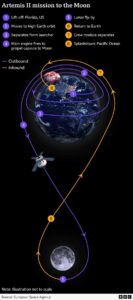
The mission follows a hybrid free-return trajectory, meaning the Moon’s gravity will naturally pull the spacecraft back toward Earth without needing a second major engine burn for the return trip.
Launch: Launched from Kennedy Space Center’s Pad 39B atop the Space Launch System (SLS) rocket.
Earth Orbit (Days 1–2): The crew orbits Earth twice to perform critical checkouts of the Orion spacecraft’s life support systems. Pilot Victor Glover also conducted proximity operations, manually flying Orion near the spent SLS upper stage to test handling qualities.
Translunar Injection (TLI): On April 2, Orion fired its main engine for roughly six minutes, accelerating the crew toward the Moon.
Lunar Flyby (Day 6): Scheduled for April 6, 2026, Orion will pass approximately 4,600 miles (7,400 km) beyond the Moon’s far side. At this point, the crew will travel farther from Earth (~252,799 miles) than any humans in history, surpassing the record set by Apollo 13.
Return & Splashdown (Day 10): After a four-day return transit, Orion will re-enter Earth’s atmosphere at speeds of 25,000 mph before splashing down in the Pacific Ocean near San Diego on April 10, 2026.
Key Objectives & Science
As a test flight, Artemis II aims to validate all systems required for the subsequent Artemis III mission, which intends to land astronauts on the lunar surface as early as 2027 or 2028.
Life Support: First test of Orion’s full environmental control systems with humans on board.
Laser Communications: Testing high-bandwidth optical communications to send high-definition video and data to Earth.
Health Studies: Investigations like AVATAR (organ-on-a-chip) and ARCHeR study the effects of deep-space radiation and microgravity on the human body.
COST DETAILS:
The Artemis II mission was a multi-billion dollar undertaking, with the cost of a single launch now estimated at approximately $4.1 billion (roughly ₹34,000 crore). This figure reflects the expensive, “single-use” nature of the mission’s core hardware and the complex systems required to support human life in deep space.
Per-Launch Cost Breakdown
Government audits from the NASA Office of Inspector General (OIG) break down the ~$4.1 billion per mission cost into the following primary components:
Space Launch System (SLS) Rocket: ~$2.2 billion per launch. The SLS is expendable, meaning a new rocket must be built for every mission.
Orion Spacecraft: ~$1 billion per mission for the crew capsule and its European-built service module.
Ground Systems: ~$568 million for launch pad operations and recovery efforts.
European Service Module: ~$300 million (contributed by the European Space Agency).
Total Program Investment
The Artemis II flight is just one milestone in a broader campaign that has seen massive cumulative spending over more than a decade.
Cumulative Cost: Through fiscal year 2025, the total Artemis program cost is projected to reach $93 billion.
Development Costs: Prior to the first Artemis launch, NASA spent nearly $24 billion developing the SLS rocket and over $20 billion on the Orion spacecraft.
Future Projections: Analysts from firms like Bloomberg and government watchdogs suggest total program spending could exceed $100 billion as NASA moves toward permanent lunar bases.
Why Is It So Expensive?
Unlike commercial rockets from SpaceX or Blue Origin, the SLS and Orion systems are largely not reusable. The high price tag is also driven by:
Redundancy: Advanced life-support, radiation shielding, and abort systems essential for crew safety.
Infrastructure: Massive upgrades to Kennedy Space Center and the construction of specialized mobile launchers (e.g., Mobile Launcher 2, which alone costs over $1.8 billion).
Contracting Models: Continued use of “cost-plus” contracts, where the government pays for all development costs plus a fee, has contributed to significant budget overruns.
SOURCE:
NASA, SPACE, Hindustan Times.
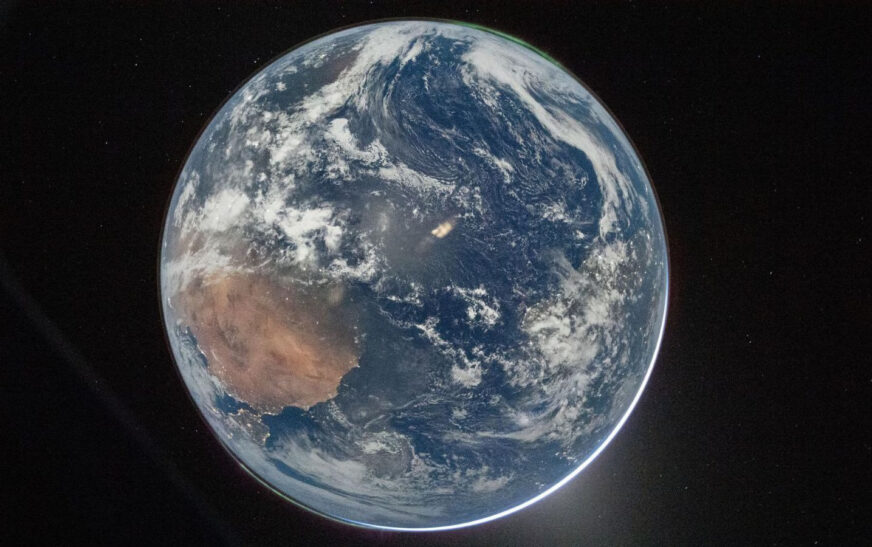
Image: 1. Photo of EARTH, sent by ARTEMIS-II. Courtesy—NASA
2.. Flight Path, & Schedule of ARTEMIS–II