
GLOBAL CHOKE POINTS
SARASIJ MAJUMDER
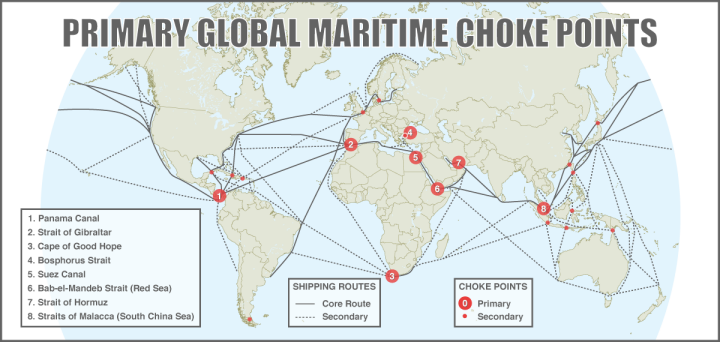
Maritime choke points are narrow, high-traffic sea lanes ( routes) critical to global trade, energy supply, and military strategy. Major choke points include the Strait of Hormuz, Suez Canal, Strait of Malacca, Bab el-Mandeb, Panama Canal, Turkish Straits, and Gibraltar. Disruptions at these bottlenecks can significantly delay shipments, increase costs, and threaten global economic stability.
Top Strategic Maritime Choke Points:
Strait of Hormuz (Iran/Oman): The world’s most critical choke point, linking the Persian Gulf with the Gulf of Oman.
Volume: Handled roughly 20–21 million barrels of oil per day (about 20% of global consumption) before war. Now average 5-10 Oil Tankers per day.
Strategic Significance: The only maritime exit for major oil producers like Saudi Arabia, Iraq, Kuwait, and the UAE.
Strait of Malacca (Malaysia/Indonesia/Singapore): The main shipping channel between the Indian Ocean and Pacific Ocean; a primary route for Asian trade. The world’s busiest oil transit chokepoint and a primary link between the Indian Ocean and the South China Sea.
Volume: Carries approximately 23.2 million barrels of oil per day.
Strategic Significance: Essential for energy imports to China, Japan, and South Korea, and handles about 25–30% of all global seaborne trade.
Suez Canal (Egypt): A vital artificial CANAL shortcut between the Mediterranean Sea and Red Sea, cutting off thousands of miles for Europe-Asia shipping route. An artificial waterway through Egypt that eliminates the need to sail around Africa, saving about 8,900 km (5,500 miles).
Bab el-Mandeb: A narrow strait between Yemen and Djibouti that acts as the “gatekeeper” to the Suez Canal.(Yemen/Djibouti/Eritrea): The link between the Red Sea and the Gulf of Aden; crucial for traffic passing through the Suez Canal. These two, in tandem, form a vital corridor between the Mediterranean Sea and the Indian Ocean.
Panama Canal (Panama): Connects the Atlantic and Pacific Oceans, vital for U.S. Gulf Coast to Asian trade routes. A lock gate-based canal connecting System.
Volume: Accounts for roughly 5% of global container trade.
Recent Risks: Faces severe vulnerability to climate change, with recent droughts forcing draft and transit restrictions due to low water levels in Gatun Lake.
Turkish Straits (Bosphorus/Dardanelles): Connects the Black Sea to the Mediterranean, acting as the primary passage for goods from Russia and Ukraine. They are crucial for Russian and Caspian oil and grain exports.
Strait of Gibraltar (Spain/Morocco): Connects the Atlantic Ocean to the Mediterranean Sea. The only natural link between the Atlantic Ocean and the Mediterranean Sea.
Other Crucial Bottlenecks
Danish Straits (Denmark/Sweden): Connects the Baltic Sea to the North Sea. A primary exit for Russian oil from Baltic ports.
Taiwan Strait: A contentious shipping lane in East Asia. A major shipping lane for the global container fleet and a critical bottleneck for the semiconductor industry.
Cape of Good Hope (South Africa): An alternative route around Africa when the Suez Canal is blocked.
Key Regional and Resource Choke Points:
Digital Choke Points: Subsea cable concentrations that facilitate global data flow.
Strategic Minerals: China acts as a primary choke point for the processing of rare earth elements, vital for high-tech industries and green energy.
These bottlenecks are critical to monitor, as they are often exposed to geopolitical tensions, piracy, and accidents, such as the 2021 Suez Canal obstruction.
Now let me discuss the alternatives:
- Suez Canal + Bab el-Mandeb:
Alternate is ‘Cape of Good Hope’ ~4,000 nm extra route, extra time 10–14 days, Additional cost is $1.5 Million.
2.0 Panama Canal:
Alternate route is Cape Horn or Magellan . Extra ~3,500–5,000 nm, Extra duration is10–15 days, Extra cost is $500,000–$800,000. Alternate route is treacherous.
3.0 Strait of Malacca:
Alternate Route is Lombok Strait or Makassar Strait. Extra route ~4,600 km, additional duration- ~7 days,~20% increase in total cost.
4.0 Strait of Hormuz:
There is no viable sea alternative. Alternative pipelines can evacuate some crude/oil via pipelines crossing land in opposite direction. Saudi Arabia, and UAE has a bypass pipeline each. But, capacity is much less.
Saudi Arabia (East-West Pipeline/Petroline): Extends from Abqaiq to Yanbu on the Red Sea, this 56-inch pipeline has a capacity of 7 million barrels per day. Following recent crises, it acts as a critical “release valve” for oil exports.
UAE (ADCOP – Abu Dhabi Crude Oil Pipeline): Connects onshore production in Habshan directly to Fujairah port on the Gulf of Oman, bypassing the strait entirely with a capacity of roughly 1.8 million bpd.
Key Economic Trade-offs in alternate routes:
Fuel vs. Tolls: For a large container ship, a Suez Canal transit toll can range from $300,000 to $700,000. While rerouting around Africa avoids this fee, the extra fuel alone typically costs over $1 million, resulting in a net loss for the operator.
Emissions Taxes: Under the European Union’s Emissions Trading System (ETS), a 20,000+ TEU vessel rerouting around Africa incurs an additional $400,000 in carbon emission costs per voyage.
Insurance Premiums: Ships continuing through high-risk chokepoints like the Red Sea face “War Risk” premiums, which have surged to roughly 0.6%–1.0% of the total cargo value in recent times.
Source:
The World Economic Forum; Boston Consulting Group; Aljazeera, Pipeline and Gas Journal; Offshore Oil & Gas.